
Home Tech Land is reader-supported. When you buy through links on our site, we may earn a commission. As an Amazon Associate, we earn from qualifying purchases.
Last updated: . How we research: We compare manufacturer specs with published lab measurements and owner reports; we don’t test products in person. Learn more about Home Tech Land.
The Sony Bravia XR A95K is Sony’s first quantum dot organic light-emitting diode (QD-OLED) television (TV), released in 2022 as one of the first QD-OLED sets on sale anywhere, and in 2026 it’s still a superb movie TV at a used price. It combined a new panel from Samsung Display with Sony’s Cognitive Processor XR, a bundled camera, and a striking stand. This Sony A95K review explains how the technology works, how the A95K performed for reviewers, what it gets wrong, and whether a used or open-box unit still makes sense now that the Bravia 8 II sits at the top of Sony’s OLED range.
Quick verdict: The A95K delivers perfect blacks, record-setting color volume for its time, bright high dynamic range (HDR) highlights, and some of the best built-in sound on any TV. Its drawbacks are only two High-Definition Multimedia Interface (HDMI) 2.1 ports, higher input lag than LG and Samsung OLEDs, a stand that leaves little room for a soundbar, and grayish blacks in bright rooms. It’s a superb movie TV at a used price, but newer OLEDs beat it on brightness and gaming. Check the Sony A95K price on Amazon.
Key takeaways
- What it is: A 2022 4K QD-OLED TV with a 120Hz panel from Samsung Display, Sony’s Cognitive Processor XR, and a bundled Bravia Cam.
- Price: It launched at $2,999.99 for 55 inches and $3,999.99 for 65 inches, and in 2026 it makes sense only as a used or open-box buy for far less than a new Bravia 8 II. Prices change often.
- Main strengths: Tom’s Guide measured 99.95% coverage of the Ultra HD Alliance P3 color space and about 1,000 nits on small HDR windows, and its built-in sound ranks among the best on any TV.
- Main weaknesses: Only two HDMI 2.1 ports, about 16 to 21 milliseconds of input lag, and grayish blacks in bright rooms.
- Successor: The A95L replaced it in 2023, and the Bravia 8 II, launched in 2025, remains Sony’s top OLED in 2026.
Sony A95K at a glance
| Spec | Sony A95K |
|---|---|
| Release year | 2022 (discontinued; succeeded by the A95L in 2023 and the Bravia 8 II in 2025) |
| Sizes and launch prices | 55 inches ($2,999.99) and 65 inches ($3,999.99) |
| Panel | First-generation 4K QD-OLED from Samsung Display, 120 hertz (Hz) refresh rate |
| Measured HDR peak brightness | About 1,000 nits on small windows, per Tom’s Guide |
| Color gamut | 99.95% of the Ultra HD Alliance P3 (UHDA-P3) color space, per Tom’s Guide |
| HDR formats | Dolby Vision, HDR10, and Hybrid Log-Gamma (HLG); no HDR10+ |
| Inputs | Four HDMI ports (two HDMI 2.1, one shared with enhanced Audio Return Channel, or eARC), Universal Serial Bus (USB), optical, Ethernet, and RS-232 |
| Gaming | 4K at 120Hz, variable refresh rate (VRR), and auto low-latency mode (ALLM); about 16 to 21 milliseconds of input lag |
| Sound | Acoustic Surface Audio+ with two 20-watt screen actuators and two 10-watt subwoofers |
| Extras | Bravia Cam included; backlit remote with find-my-remote |
Specs and measurements come from TechRadar’s launch pricing report, Tom’s Guide, and What Hi-Fi.
How QD-OLED works
Traditional OLED TVs from LG Display, like Sony’s own A90J, use white OLED subpixels with color filters on top. Filters block some light, which limits how bright saturated colors can get. QD-OLED takes a different approach. Each pixel emits blue light, and a layer of quantum dots converts part of that light into pure red and green, while blue passes straight through. Little light goes to waste, so colors stay vivid even at high brightness.
Like every OLED, each pixel switches on and off by itself, so blacks look perfect in a dark room and you never see the blooming that liquid crystal display (LCD) TVs show around bright objects. Our explainer on local dimming covers how Mini LED TVs such as the Sony X95K try to get close.
Design and build
The A95K looks unlike any other Sony TV. Its top section measures roughly half an inch thick, while the electronics module behind it brings total depth to about 1.75 inches, according to Tom’s Guide. Thin bezels on three sides give the screen a nearly frameless look, and a thicker bottom strip holds the far-field microphones and controls.
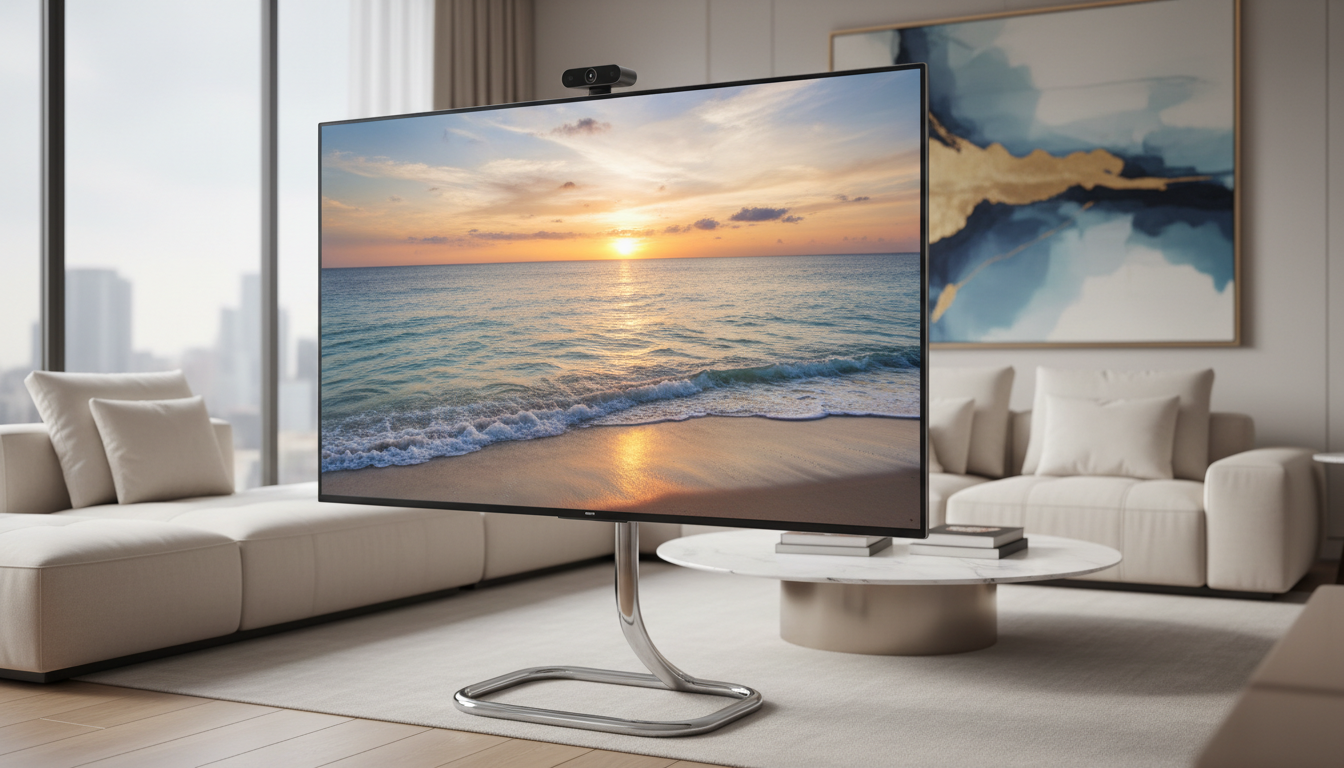
Instead of feet, the A95K uses a single arc-shaped metal stand that you can mount in two ways. Behind the screen, it hides out of sight and tilts the TV back slightly; in front, it lets the panel sit almost flush against a wall. Either way, the screen sits very low, so a soundbar in front will block the bottom of the picture. Sony includes three covers to hide cables on the textured back panel.
Picture quality
Color
Color is where the A95K made its name. Tom’s Guide measured 99.95% coverage of the UHDA-P3 color space, the best it had recorded, and about 89.5% of the wider Recommendation BT.2020 (Rec. 2020) space. In practice, that means rich, saturated colors in bright scenes, such as tropical water and sunsets, that look natural rather than cartoonish. Out of the box, Tom’s Guide recorded a Delta-E (color error) of 3.32 in Custom mode, so it isn’t the most accurate set without calibration.
Brightness and HDR
Tom’s Guide measured about 1,000 nits on small HDR windows, well above most 2022 OLEDs. What Hi-Fi noted that overall brightness looked similar to LG’s G2, but the A95K held more color and detail in the brightest highlights.
Black levels in bright rooms
The A95K reaches true black in a dark room. QD-OLED panels skip the polarizer layer that white OLED (W-OLED) panels use, though, so ambient light hitting the screen makes blacks look slightly gray or purplish. In a dim room you won’t notice, but in daytime viewing a W-OLED or a Samsung QD-OLED with an anti-glare coating handles reflections better.
Motion and processing
OLED pixels respond almost instantly, so fast motion looks crisp, and Sony’s Cognitive Processor XR adds excellent upscaling, smooth gradients, and natural skin tones.
Gaming performance
The A95K supports 4K at 120Hz, VRR, and ALLM on its two HDMI 2.1 ports. Because one also handles eARC, soundbar owners have one full-speed port left for a PlayStation 5 (PS5), an Xbox Series X, or a gaming PC. Tom’s Guide measured about 16 milliseconds of input lag and What Hi-Fi recorded 21 milliseconds, both fine for casual play but slower than LG OLEDs. What Hi-Fi also noted no HDR Gaming Interest Group (HGiG) mode or Dolby Vision gaming at review time. PS5 owners get Auto HDR Tone Mapping and Auto Genre Picture Mode. Our best gaming TVs for PS5 and Xbox guide lists sets with more HDMI 2.1 ports.
Sound, Bravia Cam, and smart features
Acoustic Surface Audio+ turns the screen into a speaker with two 20-watt actuators, backed by two 10-watt subwoofers. Tom’s Guide called it some of the best TV sound it had heard, and What Hi-Fi gave sound five stars, though a dedicated system still adds more scale. A Sony Bravia Theater soundbar can use the TV as its center channel through Acoustic Center Sync.
Sony bundles the Bravia Cam, a small camera that clips to the top of the TV. It enables video chats, gesture controls, a proximity alert for kids who sit too close, and Ambient Optimization, which adjusts picture and sound based on where you sit. Tom’s Guide found gesture control slow and preferred the remote, a backlit model with find-my-remote support. The A95K runs Google TV with Chromecast, Apple AirPlay, Apple HomeKit, and hands-free Google Assistant, and it works with Amazon Alexa devices.
Pros and cons
Pros
- Perfect blacks and vivid, record-setting color volume
- Bright HDR highlights for a 2022 OLED
- Excellent processing and upscaling
- Outstanding built-in sound
- Bravia Cam and backlit remote included
- Striking, premium design
Cons
- Only two HDMI 2.1 ports, one shared with eARC
- Higher input lag than LG and Samsung OLEDs
- Blacks look grayish in bright rooms
- Low stand leaves little room for a soundbar
- Cost far more than Samsung’s QD-OLED S95B
- Discontinued
Is the Sony A95K discontinued?
Yes. The Sony A95L replaced it in 2023 with a brighter second-generation QD-OLED panel and a more conventional stand. In 2025, the Bravia 8 II took over as Sony’s flagship QD-OLED, and it remains Sony’s top OLED in 2026, since Sony announced no new OLED models this year. What Hi-Fi noted that the A95K typically sold for about $2,500 after launch, while Samsung’s S95B cost around $1,450, so Sony’s version always carried a premium.
Sony A95K vs. current premium OLED TVs
Compare similar premium OLED TVs on Amazon
Amazon is our main affiliate partner, and it carries the A95K’s successors and today’s best premium OLED alternatives. Prices change often, so check current deals.
| TV | Panel | HDMI 2.1 ports | Best for | Shop |
|---|---|---|---|---|
| Sony A95K (2022) | QD-OLED (first gen) | Two | Movie fans buying used or open box | Check price |
| Sony A95L (2023) | QD-OLED (second gen) | Two | A brighter Sony flagship on clearance | Check price |
| Sony Bravia 8 II (2025) | QD-OLED | Two | The current top Sony OLED | Check price |
| Samsung S95H (2026) | QD-OLED with anti-glare screen | Four | Bright rooms and serious gaming | Check price |
| Samsung S90F (2025) | QD-OLED or W-OLED, by size | Four | Premium OLED picture for less | Check price |
| LG C5 (2025) | W-OLED | Four | Gamers who want an all-rounder | Check price |
- Sony Bravia 8 II: It keeps Sony’s natural processing with a much brighter panel, but still offers only two HDMI 2.1 ports. It launched at $3,499 for 55 inches and $3,999 for 65 inches, and sales have since cut those prices. See the Sony Bravia 8 II on Amazon.
- Samsung S95H: Samsung’s 2026 flagship adds an anti-glare matte screen that fixes the A95K’s bright-room black levels, plus four HDMI 2.1 ports. See the Samsung S95H on Amazon.
- Samsung S90F: Our Samsung S90F review explains why it’s a strong value OLED, with lower input lag than Sony’s OLEDs. See the Samsung S90F on Amazon.
- LG C5: A popular all-rounder with four HDMI 2.1 ports and low input lag. See the LG C5 on Amazon.
Who should buy the Sony A95K?
Buy the A95K if you find a well-kept used or open-box unit for far less than a new Bravia 8 II, you watch mostly movies in a room you can darken, and you want great sound without a soundbar. Check for burn-in, confirm the Bravia Cam and remote come with it, and measure your furniture for the deep stand. Skip it if you game on several consoles, watch in a sunny room, or want a warranty. A Video Electronics Standards Association (VESA) wall mount solves the soundbar problem, and the Sony X90CK covers Sony’s 2022 midrange option.
Frequently asked questions
Is the Sony A95K still worth buying?
The Sony A95K is worth buying only at a strong used or open-box price. Its picture and sound still impress, but newer OLEDs are brighter and better for gaming.
Does the Sony A95K have perfect blacks?
Yes, the Sony A95K has perfect blacks in a dark room. In bright rooms, ambient light can make blacks look slightly gray because QD-OLED panels lack a polarizer.
What replaced the Sony A95K?
The Sony A95L replaced the A95K in 2023, and the Bravia 8 II replaced the A95L in 2025. The Bravia 8 II is Sony’s top OLED in 2026.
Does the Sony A95K come with a camera?
Yes, the Sony A95K comes with a camera: new units shipped with the Bravia Cam for video calls, gesture control, and Ambient Optimization.
Final verdict
The Sony A95K proved what QD-OLED could do, with stunning color, perfect blacks, bright highlights, and superb sound. Two HDMI 2.1 ports, middling input lag, bright-room black levels, and an awkward stand kept it from perfection, and the A95L and Bravia 8 II have since improved on it. At a used price, it’s still a beautiful movie TV. Check the current Sony A95K price on Amazon, or compare the Sony Bravia 8 II on Amazon.