
Home Tech Land is reader-supported. When you buy through links on our site, we may earn a commission. As an Amazon Associate, we earn from qualifying purchases.
Skyworth isn’t a household name in the United States (US), but it ranks among the world’s biggest television (TV) makers. This Skyworth TV review looks at the Skyworth XC9300, the company’s 4K organic light-emitting diode (OLED) TV from 2021, which still turns up on clearance and in the used market. We cover what it does well, where it falls short in 2026, what Skyworth sells today, and which current TVs on Amazon make better buys for most people.
Quick verdict: The Skyworth XC9300 delivers the perfect blacks, wide viewing angles, and rich color of an OLED panel at a bargain price when you find it on sale. Its High-Definition Multimedia Interface (HDMI) 2.0 ports, 60 hertz (Hz) gaming limit, modest brightness, and aging Android TV software make it a TV for movie fans rather than gamers. Discontinued stock is scarce, so most shoppers will get more from a current budget OLED. Check the Skyworth TV price on Amazon.
Skyworth XC9300 at a glance
| Spec | Skyworth XC9300 |
|---|---|
| Release year | 2021 (discontinued) |
| Sizes | 55 inches (55XC9300) and 65 inches (65XC9300) |
| Panel | 4K white OLED (WOLED) panel with a 120Hz native refresh rate |
| Peak brightness | About 500 nits (manufacturer rating) |
| High dynamic range (HDR) formats | HDR10, Hybrid Log-Gamma (HLG), and Dolby Vision |
| Inputs | Three HDMI 2.0b ports, one with Audio Return Channel (ARC); optical, coaxial, Ethernet, headphone jack, and Universal Serial Bus (USB) |
| Gaming | Variable refresh rate (VRR) support; game mode limited to 60Hz |
| Smart platform | Android TV with Google Assistant and Chromecast built in; works with Amazon Alexa |
| Audio | 2 x 10-watt rear-facing speakers with Dolby Atmos and Digital Theater Systems (DTS) decoding |
| Launch price | About $1,350 to $2,000 depending on size; the 65-inch sold for as little as $649 on clearance in 2023 |
Specs come from OLED-Info, retailer The Brick’s spec sheet, TechRadar, and Reviewed.
Who is Skyworth?
Skyworth started in 1988 making remote controls and decoders in Shenzhen, China, and grew into a full TV manufacturer. It produces many of its own components, sells TVs under its own name and its Coocaa brand, and owns the German TV brand Metz. Over the past decade, it bought Sinotec in South Africa, Strong Group, and a former Toshiba factory in Indonesia, according to KrASIA.
The company’s scale is bigger than its US profile suggests. Omdia research cited by KrASIA shows that Skyworth passed Sony in global TV sales revenue share in early 2025, putting it in the top five worldwide alongside Samsung, LG, TCL, and Hisense. In February 2026, Panasonic also handed production, research and development, and sales of its European TVs to Skyworth, a deal that took effect on April 1, 2026, according to What Hi-Fi?.
Can you still buy a Skyworth TV in the US in 2026?
Skyworth announced a big US push at the Consumer Electronics Show (CES) in January 2021, with five TV series led by the XC9300 OLED. That push faded quickly. The company never built the kind of retail presence TCL and Hisense have at Best Buy, Walmart, and Costco, and it no longer markets a current lineup to US shoppers. Today, you mostly find Skyworth TVs through third-party sellers on Amazon and Walmart’s marketplace, at Canadian retailers, or secondhand.
Outside North America, Skyworth’s current lineup looks very different from the XC9300. Its newer TVs run Google TV and lean heavily on Mini LED (miniature light-emitting diode) and quantum dot LED (QLED) designs, including the SUE9600 Mini LED and the Q6600H QLED series sold in Australia, Asia, and the Middle East. At the April 2026 Canton Fair, Skyworth showed OLED, RGB (red, green, and blue) Mini LED, and quantum dot Mini LED models, but it hasn’t announced US versions.
That matters for support. If you buy an XC9300 today, expect limited or no manufacturer warranty, few software updates, and a thin network of authorized repair shops. Buy from a seller with a solid return policy, and consider a third-party protection plan.
Design and build
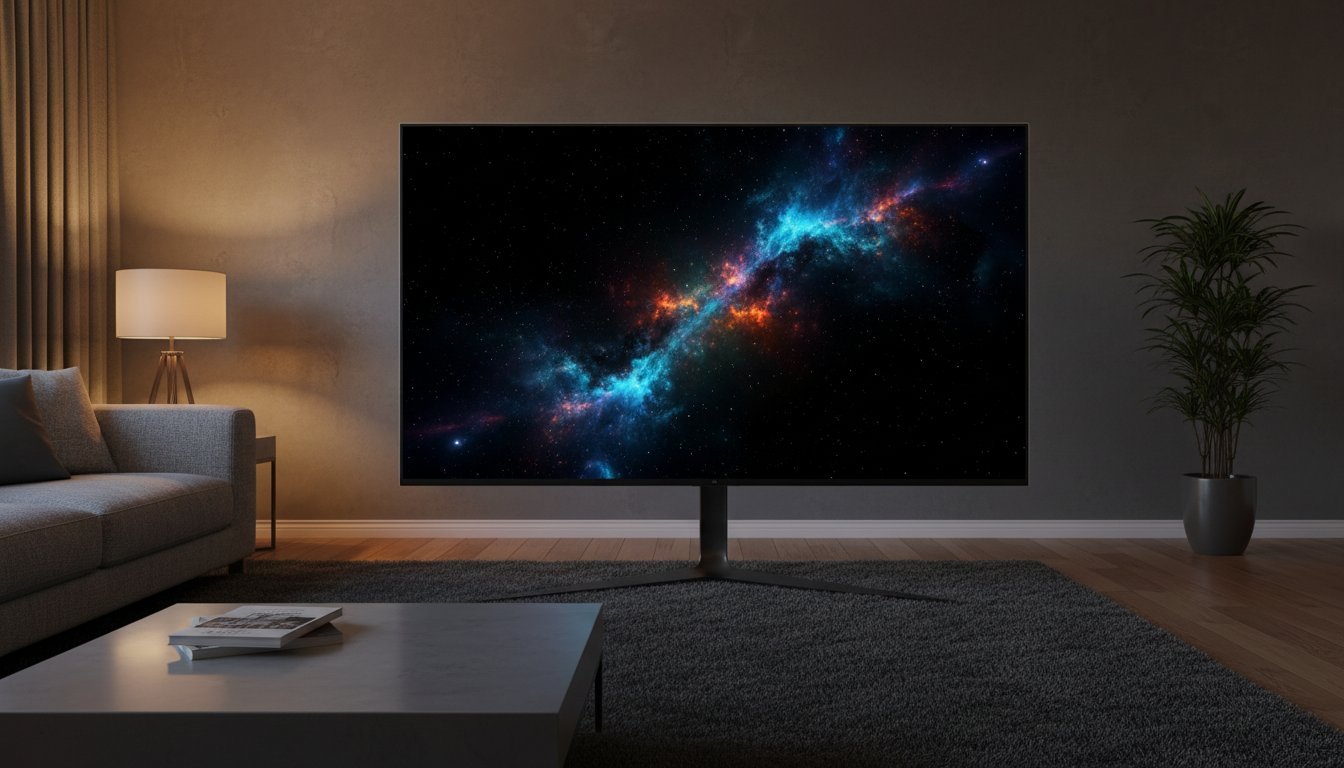
The XC9300 looks premium for its price. Thin, dark bezels and metallic edges frame the screen, and a central metal pedestal stand with a slight backward tilt holds it steady. The stand leaves less than two inches of clearance under the screen, so most soundbars will block the bottom of the picture. If you plan to add one, wall mounting solves the problem. The panel uses a standard 300 x 200 millimeter Video Electronics Standards Association (VESA) pattern, so it works with common mounts like those in our guide to the best TV wall mounts for 65-inch TVs.
Like most OLED TVs, the panel is thin at the top, with a thicker section at the bottom for the electronics and ports. The rear-facing ports are harder to reach once the TV hangs on a wall, so connect your cables before you mount it.
Connectivity
The XC9300 has three HDMI 2.0b inputs, one of which supports ARC for sending audio to a soundbar or receiver. It also includes a digital optical output, a coaxial antenna input, Ethernet, a headphone jack, USB ports, and dual-band Wi-Fi. The set passes Dolby Atmos audio to compatible sound systems.
The big omission is HDMI 2.1. Without it, the TV can’t accept 4K signals at 120Hz, so the PlayStation 5 (PS5) and Xbox Series X run at 60Hz. It also lacks enhanced Audio Return Channel (eARC), which means it can’t pass lossless Dolby TrueHD Atmos from streaming apps to a soundbar the way newer TVs can.
Smart TV platform: Android TV
The XC9300 runs Android TV, the predecessor to Google TV. You get the Google Play Store with all the major streaming apps, Google Assistant voice control, and built-in Chromecast for casting from your phone. The TV also works with Amazon Alexa devices. It doesn’t support Apple AirPlay.
Android TV still works in 2026, but the XC9300’s version is old, and Skyworth doesn’t push regular updates in the US. Some apps may eventually stop supporting it, and the interface can feel sluggish. A cheap streaming stick fixes both problems: plug in a Google TV streaming device or Roku stick, and you get a modern, regularly updated interface.
Picture quality
The XC9300 uses a white OLED (WOLED) panel, the same core technology LG uses in its OLED TVs. LG Display is the only company that produces large WOLED TV panels, which is why the original version of this review described it as an LG panel. Each pixel makes its own light and turns off completely, so the TV shows true black and infinite contrast with no blooming around bright objects.
Contrast and HDR
Perfect blacks give the XC9300 a big advantage in dark rooms, where shadows and night scenes look deep and detailed. Brightness is the weak spot. Its roughly 500-nit peak matches budget OLEDs of its era, such as the LG A1, and sits at about half the brightness of 2021’s LG C1, according to TechRadar. HDR highlights look good in a dim room but lack punch in a bright one. Current budget OLEDs do better: Tom’s Guide measured about 695 nits of HDR brightness on the 2026 LG B6, and Mini LED TVs such as the Hisense U7SG top 2,800 nits.
Color
Skyworth claimed more than 90% coverage of the Digital Cinema Initiatives P3 (DCI-P3) color space used for HDR movies, which is typical for WOLED panels. Owners describe the picture as vivid and natural, though the default color temperature leans slightly cool. Switching to a warm or movie picture mode corrects most of that blue tint. Dolby Vision support also helps, because many Netflix, Disney+, and Apple TV+ titles use it.
Viewing angles
Like every OLED, the XC9300 keeps its colors and contrast when you sit off to the side. That makes it a good fit for wide living rooms and movie nights with a full couch.
Motion and gaming
OLED pixels respond almost instantly, so motion looks crisp in sports and fast games. The XC9300 supports VRR to reduce screen tearing, but its game mode tops out at 60Hz, and early reviewers such as Linus Tech Tips flagged the missing HDMI 2.1 as its main weakness. Casual gamers will be fine, but anyone who wants 120 frames per second on a PS5, Xbox Series X, or gaming personal computer (PC) should look elsewhere. Our guide to the best gaming TVs for PS5 and Xbox covers better options, and our explainer on 60Hz vs. 120Hz TVs explains why the difference matters.
Burn-in risk
All OLEDs can suffer permanent image retention if they show the same static image, such as a news ticker or game interface, for hours every day. Newer OLEDs have better panels and protection features, and LG and Samsung back theirs with established warranties. With a discontinued Skyworth, you take on that risk yourself, so vary what you watch and leave the TV’s pixel-refresh features turned on.
Sound
Two 10-watt rear-facing speakers handle audio, with Dolby Atmos and DTS decoding. Like most thin TVs, the XC9300 sounds fine for news and casual viewing but lacks bass and dialogue clarity for movies. A soundbar makes a big difference, but remember to wall mount the TV or pick a low-profile model because of the short stand.
Pros and cons
Pros
- Perfect blacks and infinite contrast from the OLED panel
- Wide viewing angles
- Dolby Vision, HDR10, and HLG support
- Built-in Chromecast and Google Assistant
- Excellent value when you find it on clearance
Cons
- No HDMI 2.1, so console gaming tops out at 4K and 60Hz
- No eARC and only three HDMI ports
- Dim by current OLED and Mini LED standards
- Aging Android TV software with few updates
- Limited US warranty and repair support
- No Apple AirPlay support
Current alternatives to the Skyworth XC9300
Since the XC9300 is discontinued, it only makes sense at a deep discount. Amazon is our main affiliate partner, and it carries current budget OLED and Mini LED TVs that outperform the XC9300 on brightness, gaming features, and software support.
Compare similar TVs on Amazon
| TV | Panel type | Gaming | Best for | Shop |
|---|---|---|---|---|
| Skyworth XC9300 (2021) | OLED | 4K at 60Hz, HDMI 2.0 | Dark-room movies on a tight budget | Check price |
| LG B6 OLED (2026) | OLED | 4K at 120Hz, four HDMI 2.1 ports | The best-value current OLED | Check price |
| Samsung S90F OLED (2025) | QD-OLED (quantum dot OLED) | 4K at up to 144Hz, four HDMI 2.1 ports | A brighter OLED with vivid color | Check price |
| TCL QM6K | QLED with Mini LED backlight | 4K at up to 144Hz | Bright rooms on a tight budget | Check price |
| Hisense U7SG (2026) | QLED with Mini LED backlight | 4K at up to 165Hz, four HDMI 2.1 ports | Gaming and sports for the money | Check price |
- LG B6 OLED: LG’s entry OLED delivers the same perfect blacks as the XC9300 with more brightness, four HDMI 2.1 ports, and current webOS software. Tom’s Guide named it the best-value OLED of 2026, and the 65-inch has dropped near $1,000 during sales. See the LG B6 on Amazon.
- Samsung S90F: This quantum dot OLED (QD-OLED) gets brighter than most budget OLEDs and produces more saturated color. Read our Samsung S90F review for details. See the Samsung S90F on Amazon.
- Hisense U7SG and TCL QM6K: These Mini LED TVs can’t match OLED black levels, but they get several times brighter and cost less. Tom’s Guide measured more than 2,800 nits of HDR brightness on the U7SG. Our TCL vs. Hisense comparison helps you choose. See the Hisense U7SG on Amazon.
If you want to stay under $1,000 for a big screen, see our list of the best 65-inch TVs under $1,000.
Who should buy the Skyworth XC9300?
Buy the XC9300 only if you find it well under the price of a current budget OLED, you watch mostly movies and TV shows in a dim room, and you don’t need 120Hz gaming. Check that the seller offers returns, and inspect the screen for burn-in if you buy it used. Everyone else, including PS5 and Xbox owners and anyone with a bright living room, should choose a current LG B6 OLED or a Mini LED TV such as the Hisense U7SG.
Frequently asked questions
Is Skyworth a good TV brand?
Skyworth is a legitimate, major manufacturer that sells millions of TVs a year, mainly in China, Asia, Europe, Africa, and Australia. The catch for US buyers is support: with no strong US retail presence, warranty service and software updates are harder to get than with LG, Samsung, TCL, or Hisense.
Who makes Skyworth OLED panels?
The XC9300 uses a WOLED panel. LG Display is the only company that makes large WOLED TV panels, and it produces them at plants in South Korea and Guangzhou, China.
Does the Skyworth XC9300 support 4K at 120Hz?
No. The panel refreshes at 120Hz, but its HDMI 2.0b ports and 60Hz game mode limit consoles and PCs to 4K at 60Hz.
What replaced the Skyworth XC9300?
Skyworth hasn’t released a direct US successor. Its newer global TVs run Google TV and focus on Mini LED and QLED models. In the US, the LG B6 is the closest modern equivalent for budget OLED shoppers.
Final verdict
The Skyworth XC9300 proved that a lesser-known brand could deliver real OLED picture quality, with perfect blacks, wide viewing angles, and Dolby Vision, for less than the big names. Five years later, its dim highlights, HDMI 2.0 ports, and fading software support hold it back. Grab one only at a true clearance price for a movie-focused room, and go with a current budget OLED or Mini LED TV if you game or want years of updates. Check the current Skyworth TV price on Amazon, or compare the LG B6 OLED on Amazon.