
Home Tech Land is reader-supported. When you buy through links on our site, we may earn a commission. As an Amazon Associate, we earn from qualifying purchases.
Last updated: . How we research: We compare manufacturer specs with published lab measurements and owner reports; we don’t test products in person. Learn more about Home Tech Land.
The MSI GeForce RTX 4090 Gaming Trio is MSI’s entry-level take on Nvidia’s flagship graphics card from the RTX 40 series, and in 2026 it’s still a 4K powerhouse but a niche buy at today’s inflated used prices. It launched in October 2022 at $1,599, the same price as Nvidia’s own Founders Edition, and it delivered the fastest gaming performance of its generation. This MSI RTX 4090 Gaming Trio review explains what the card offers, how it performs according to major reviewers, what you should know about the melting power connector reports, and how it stacks up against the RTX 5090 and other graphics cards on Amazon in 2026.
Quick verdict: The RTX 4090 Gaming Trio runs cool and quiet and still handles 4K gaming with ray tracing better than almost anything except the RTX 5090. Nvidia has ended production, though, and memory shortages have pushed used prices above the card’s launch price, so most gamers get better value from an RTX 5080 or Radeon RX 9070 XT. Check the MSI RTX 4090 Gaming Trio price on Amazon.
Key takeaways
- What it is: MSI’s version of Nvidia’s GeForce RTX 4090 flagship graphics card, launched in October 2022 with 24 gigabytes (GB) of memory and a four-slot cooler.
- Price: It launched at $1,599, but resale trackers put used prices at roughly $2,100 to $2,700 in August 2026. Prices change often.
- Main strengths: TechSpot measured a 13-game average of 145 frames per second at 4K, and the cooler stays very quiet under load.
- Main weaknesses: Nvidia has ended production, the card blocks four expansion slots, and its 16-pin 12VHPWR power connector needs careful installation.
- Alternatives: The RTX 5090 runs about 26 percent faster at 4K in TechRadar’s testing, while the RTX 5080 ($999 at launch) and Radeon RX 9070 XT offer better value for most gamers.
MSI RTX 4090 Gaming Trio at a glance
| Spec | MSI GeForce RTX 4090 Gaming Trio |
|---|---|
| Graphics processing unit (GPU) | Nvidia AD102 (Ada Lovelace architecture), built on the Taiwan Semiconductor Manufacturing Company (TSMC) 4N process |
| Cores | 16,384 Compute Unified Device Architecture (CUDA) cores, 512 Tensor cores, and 128 ray tracing cores |
| Boost clock | 2,520 megahertz (MHz); 2,535MHz in MSI Center’s Extreme Performance mode |
| Memory | 24 gigabytes (GB) of Graphics Double Data Rate 6X (GDDR6X) at 21 gigabits per second on a 384-bit bus |
| Outputs | Three DisplayPort 1.4a and one High-Definition Multimedia Interface (HDMI) 2.1a |
| Power | 450 watts (W) through one 16-pin 12VHPWR connector; 850W power supply recommended |
| Size and weight | 337 x 140 x 77 millimeters (mm), about 4.8 pounds; occupies four slots |
| Launch price | $1,599 |
Sources: MSI’s specification page, The FPS Review, and Club386’s review of the closely related Gaming X Trio.
Design and cooling
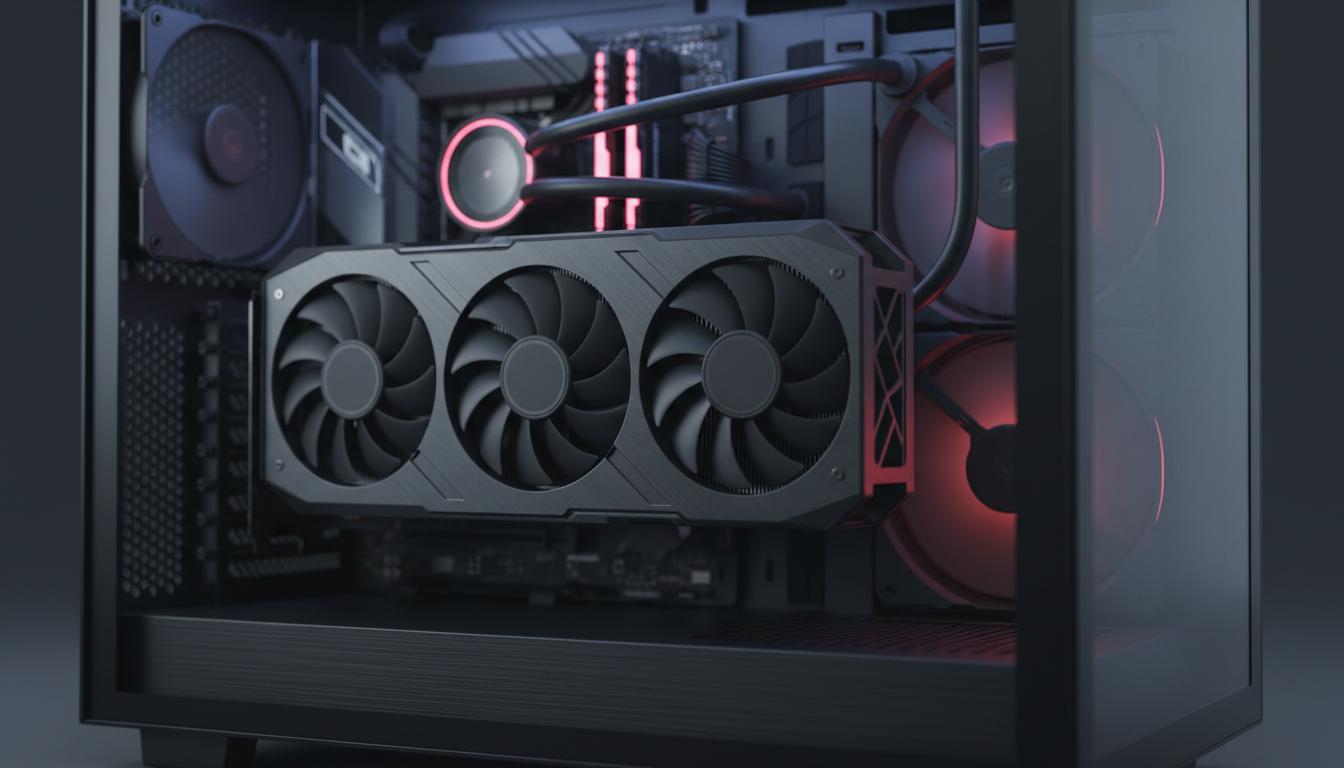
The Gaming Trio is enormous. At more than 13 inches long and nearly 3 inches thick, it blocks four expansion slots, so measure your case before you buy. Club386 called the Gaming X Trio, which uses the same cooler, the largest RTX 4090 it had tested. MSI includes a support bracket to keep the 4.8-pound card from sagging, though Club386 found it awkward to install.
The cooler pairs three MSI TORX Fan 5.0 fans with a copper base plate and eight copper heat pipes. The fans stop completely until the GPU reaches 60 degrees Celsius, so the card stays silent during light use. Club386 measured less than 35 decibels (dB) while gaming and described the card as amazingly quiet. A metal backplate stiffens the card and adds cutouts for airflow.
The Gaming Trio and the pricier Gaming X Trio share this design. The X version adds a small factory overclock, a difference worth only a few frames per second (fps).
Architecture and features
The RTX 4090 uses a cut-down version of Nvidia’s AD102 chip, with 128 of its 144 streaming multiprocessors enabled. Each streaming multiprocessor holds 128 CUDA cores, four fourth-generation Tensor cores for artificial intelligence (AI) work, and one third-generation ray tracing core. The chip packs 76.3 billion transistors, about 2.7 times as many as the RTX 3090, and 72 megabytes (MB) of level 2 (L2) cache.
The headline feature at launch was Deep Learning Super Sampling (DLSS) 3 with Frame Generation, which uses AI to insert generated frames between rendered ones. It boosts smoothness dramatically, though it adds some latency and can create artifacts on fast-moving user interface elements such as crosshairs. Shader Execution Reordering also improves ray tracing efficiency by reorganizing shading work on the fly. In 2025, Nvidia’s DLSS 4 brought an improved upscaling model to RTX 40 cards, but Multi Frame Generation, which inserts up to three generated frames, remains exclusive to the RTX 50 series.
Gaming performance
Reviewers called the RTX 4090 a generational leap. TechSpot’s RTX 4090 review measured a 13-game average of 145 fps at 4K (3840 x 2160), 59 percent faster than the RTX 3090 Ti. In Cyberpunk 2077 at 4K with ultra ray tracing, the card averaged about 45 fps natively and 113 fps with DLSS 3 Frame Generation. Efficiency impressed too: capped at 90 fps, the RTX 4090 drew just 215W.
The card shines at 4K. At 1080p, and often at 1440p (2560 x 1440), your processor becomes the bottleneck, so esports titles gain little over older cards. Pair it with a fast gaming processor such as AMD’s Ryzen 7 9800X3D. A budget chip like the Ryzen 7 8700F works well with midrange cards but would hold back a 4090. Because the Gaming Trio runs at Nvidia’s reference clocks, its performance matches the Founders Edition.
The 12VHPWR melting connector issue
Weeks after launch, owners reported melted 16-pin 12VHPWR power connectors on RTX 4090 cards. According to PCWorld, Nvidia confirmed about 50 cases by November 2022 and said improper insertion was the likely cause. Gamers Nexus found that connectors not fully seated, sometimes combined with debris or strain from sharp cable bends, created hot spots, and it cited an estimated failure rate of 0.05 to 0.1 percent. Nvidia honored warranty claims.
In 2023, the Peripheral Component Interconnect Special Interest Group (PCI-SIG) revised the design into the 12V-2×6 connector, with shorter sensing pins so the card won’t draw full power unless the plug sits fully in place. Reports of melted connectors continued on some RTX 5090 cards in 2025, so the precautions still apply:
- Push the plug in until it clicks, with no visible gap
- Avoid sharp bends within about 1.5 inches of the connector
- Use a native 12V-2×6 cable from an Advanced Technology eXtended (ATX) 3.1 power supply instead of the bundled three-way 8-pin adapter
- Check the connector occasionally for discoloration
A quality ATX 3.1 power supply from Amazon with a native cable removes the bulky adapter from your build.
RTX 4090 availability and pricing in 2026
Nvidia wound down RTX 4090 production in late 2024 to make room for the RTX 50 series, and new stock has largely disappeared. In 2026, AI data centers’ demand for memory has driven up graphics card prices across the board. Resale trackers cited by Tech Insider put used RTX 4090 prices at roughly $2,100 to $2,700 in August 2026, well above the original $1,599. Buy a used card only from a seller with a return policy, and inspect the power connector.
RTX 4090 vs. RTX 5090 and the RTX 50 series
Nvidia launched the GeForce RTX 5090 on January 30, 2025, at $1,999. It has 32GB of faster GDDR7 memory, 21,760 CUDA cores, and a 575W power rating. TechRadar found it about 26 percent faster than the RTX 4090 at 4K, and about 34 percent faster with ray tracing. The RTX 5090 has been hard to find near its list price, and TechSpot reported most models selling for $2,500 to $3,500 in early 2026.
Lower in the lineup, the RTX 5080 ($999 at launch) trails the RTX 4090 in raw speed and has only 16GB of memory, but it adds Multi Frame Generation and uses less power. Nvidia skipped an RTX 50 Super refresh at the CES 2026 trade show, and reports say it has delayed those cards indefinitely. AMD’s Radeon RX 9070 XT offers strong 1440p and 4K performance for far less money.
Pros and cons
Pros
- Excellent 4K and ray tracing performance
- Cool and very quiet cooler with fan stop
- 24GB of memory for games, AI, and creative work
- Strong efficiency for its performance class
- Support bracket included
Cons
- Discontinued, with used prices above launch price
- Massive four-slot card that won’t fit every case
- 12VHPWR connector requires careful installation
- No DLSS 4 Multi Frame Generation
- Bundled bracket is awkward to fit
Compare the RTX 4090 to other high-end graphics cards
Amazon is our main affiliate partner, and it carries the RTX 4090 and its main rivals. Launch prices appear below; street prices in 2026 often run much higher, so check current listings.
Compare similar high-end graphics cards on Amazon
| Graphics card | Memory | Launch price | Best for | Shop |
|---|---|---|---|---|
| MSI GeForce RTX 4090 Gaming Trio | 24GB GDDR6X | $1,599 | 4K gaming if you find a fair price | Check price |
| Nvidia GeForce RTX 5090 | 32GB GDDR7 | $1,999 | The fastest 4K and AI performance | Check price |
| Nvidia GeForce RTX 5080 | 16GB GDDR7 | $999 | High-refresh 4K with Multi Frame Generation | Check price |
| Nvidia GeForce RTX 5070 Ti | 16GB GDDR7 | $749 | 1440p and entry 4K gaming | Check price |
| AMD Radeon RX 9070 XT | 16GB GDDR6 | $599 | Best value for 1440p and 4K | Check price |
| AMD Radeon RX 7900 XTX | 24GB GDDR6 | $999 | Large memory buffer for less | Check price |
- RTX 5090: The only consumer card that clearly beats the 4090, if you can stomach its price and 575W power draw. See RTX 5090 cards on Amazon.
- RTX 5080: A newer card with a warranty, lower power draw, and Multi Frame Generation, usually for much less than a used 4090. See RTX 5080 cards on Amazon.
- RX 9070 XT: The value pick for gamers who don’t need flagship speed. See the RX 9070 XT on Amazon.
Who should buy the MSI RTX 4090 Gaming Trio?
Buy it if you game at 4K with ray tracing, need 24GB of memory for AI or creative work, have a large case and a power supply of at least 850W, and find one for well under the price of an RTX 5090. Skip it if you game at 1080p or 1440p, want a warranty, or care about the latest DLSS features. A sturdy anti-sag GPU support stand is a smart addition for any card this heavy.
Frequently asked questions
What power supply does the RTX 4090 Gaming Trio need?
The RTX 4090 Gaming Trio needs a power supply of at least 850W, according to MSI. An ATX 3.0 or 3.1 unit with a native 16-pin cable is the cleanest option.
Is the RTX 4090 discontinued?
Yes, the RTX 4090 is discontinued. Nvidia ended production in late 2024, so most cards sold today are used, refurbished, or leftover stock.
Is the RTX 5090 worth it over a 4090?
The RTX 5090 is worth it over a 4090 only when the price gap is small. The 5090 runs about 26 to 34 percent faster at 4K and adds Multi Frame Generation, but it costs more and draws 575W.
Does the RTX 4090 support DLSS 4?
The RTX 4090 partly supports DLSS 4. RTX 40 cards get DLSS 4’s improved upscaling and Frame Generation, but not Multi Frame Generation.
Final verdict
The MSI RTX 4090 Gaming Trio remains a superb 4K graphics card with a quiet, effective cooler and reference-level performance. Its size, connector caveats, and inflated used prices make it a niche buy in 2026, best for 4K gamers and creators who find one at a fair price. Check the current MSI RTX 4090 Gaming Trio price on Amazon.