
Home Tech Land is reader-supported. When you buy through links on our site, we may earn a commission. As an Amazon Associate, we earn from qualifying purchases.
Last updated: . How we research: We compare manufacturer specs with published lab measurements and owner reports; we don’t test products in person. Learn more about Home Tech Land.
The best deals on car speakers in 2026 come from buying the right size, prioritizing sensitivity over flashy wattage, and shopping during Black Friday, Prime Day, or model clearances. Factory car speakers are built to a budget. Automakers use thin paper cones, small magnets, and cheap tweeters because most buyers never notice, until they play a favorite song and hear muddy bass and harsh highs. The good news: a pair of quality aftermarket speakers often costs $70 to $150, and it’s one of the cheapest upgrades that makes a real difference. This guide shows you how to find the best deals on car speakers in 2026, from choosing the right size and type to timing your purchase and saving on installation.
Quick verdict: For most drivers, a 6.5-inch coaxial pair with high sensitivity (90 decibels or more) gives the biggest improvement on a factory stereo. Models such as the JBL Club 64 and Infinity Reference REF-6532ex fit that bill, and they often drop 20% to 30% during big sales. Check the JBL Club 64 price on Amazon.
Key takeaways
- Best pick: For most factory stereos, a 6.5-inch coaxial pair rated 90 decibels or more in sensitivity, such as the JBL Club 64 or Infinity Reference REF-6532ex, gives the biggest improvement.
- Price: A quality aftermarket pair often costs $70 to $150, and popular models often drop 20% to 30% during big sales. Prices change often.
- When to buy: Black Friday (November 27, 2026) through Cyber Monday (November 30, 2026), Amazon Prime Day, and model changeovers bring the deepest discounts.
- Ways to save more: Open-box and refurbished speakers can save 15% to 40%, and doing the installation yourself avoids shop fees of about $50 to $100 or Best Buy’s $149.99 component speaker installation.
- What to ignore: Peak or max wattage claims; compare continuous root mean square (RMS) power and sensitivity instead.
Step 1: Find the right speaker size for your car
Before you compare deals, find out what fits. Car speakers come in many sizes, and automakers don’t use a standard mounting pattern. The most common sizes are:
- 6.5 inches (6-1/2 inches): The most common door speaker size
- 6 x 9 inches: Common in rear decks and some front doors; the larger cone produces fuller bass
- 5.25 inches and 6 x 8 inches: Found in many compact cars, trucks, and Ford and Mazda models
- 3.5 inches and 4 inches: Dashboard and corner speakers
Retailer fit guides such as Crutchfield’s tell you the exact sizes, mounting depth, and any adapter brackets your vehicle needs. Mounting depth matters as much as diameter, since deep magnets can hit the window glass inside the door. Universal brackets and wiring harness adapters usually cost $10 to $25 and save you from cutting factory wires.
Step 2: Choose coaxial or component speakers
Coaxial speakers
Coaxial (or full-range) speakers mount the tweeter in the center of the woofer, so one unit handles the full frequency range. They drop straight into factory locations, cost less, and suit most upgrades. Some coaxials advertise three or four “ways” (extra tweeters), but more drivers don’t automatically mean better sound.
Component speakers
Component systems separate the woofer, tweeter, and crossover (a filter that sends high frequencies to the tweeter and lower ones to the woofer). Mounting the tweeter higher, near the dashboard or the door’s sail panel, lifts the soundstage to ear level, which Crutchfield notes helps you hear high notes that road noise would otherwise muddy. They sound more realistic but cost more and take longer to install, since the tweeters need their own mounting spots.
Deal tip: If you’re on a budget, put your money into a good front pair. The front speakers do most of the work, and many people leave the rear factory speakers in place or upgrade them later.
Step 3: Understand power, sensitivity, and impedance
Speaker boxes love big numbers, but most of them don’t matter much. Here’s what to look at:
- Root mean square (RMS) power: The continuous power a speaker handles. Ignore “peak” or “max” watts, which marketers inflate. A pair rated for 400 watts peak might handle only 50 to 75 watts RMS.
- Sensitivity: How loud a speaker plays with a given amount of power, measured in decibels (dB). This matters most if you keep your factory stereo, which typically puts out only about 15 to 20 watts RMS per channel. A speaker rated 92 dB or higher plays noticeably louder on low power than one rated 88 dB.
- Impedance: Electrical resistance, measured in ohms. Most car speakers are 4 ohms, while JBL and Infinity often use 3-ohm designs that draw a bit more power from factory stereos to play louder.
Watch how brands measure sensitivity. Some test at 1 watt from 1 meter away, while others test at 2.83 volts, which delivers more than 1 watt into speakers under 4 ohms and makes the number look higher. Compare like with like.
If you want high-power speakers that handle 75 to 100 watts RMS, plan to add an amplifier. Without one, those speakers can actually sound quieter than efficient budget models.
Step 4: Time your purchase
Car speakers follow the same sale cycles as other electronics. These are the best windows to shop:
- Black Friday and Cyber Monday: In 2026, Black Friday falls on November 27 and Cyber Monday on November 30. Amazon, Crutchfield, Best Buy, and Walmart typically run their deepest car audio discounts that week, and many deals start in early November.
- Amazon Prime Day: Amazon moved it to June 23 to 26 in 2026 (it ran in July in earlier years), and its fall Prime Big Deal Days event followed in October. JBL, Pioneer, Kicker, and Rockford Fosgate speakers often see 20% to 40% discounts.
- Spring and Father’s Day sales: Retailers push car audio ahead of road trip season.
- Model changeovers: When a brand launches a new series, the outgoing model often drops sharply. Pioneer’s previous A-Series models, for example, show up at clearance prices once a new line arrives.
Use a price tracker such as CamelCamelCamel or Keepa to see a speaker’s price history on Amazon, so you know whether a “deal” is really a deal.
Step 5: Consider open-box and refurbished speakers
Speakers have few parts that wear out, so open-box and refurbished units can save 15% to 40%. Best Buy’s open-box section, Crutchfield’s Outlet, and Amazon Resale (formerly Amazon Warehouse) all sell returned speakers that are often unused. A few rules keep you safe:
- Buy from a retailer with a clear return window, ideally 30 days or more
- Check that grilles, mounting hardware, and crossovers (for component sets) are included
- Avoid used speakers with torn surrounds or dented cones
- Confirm whether the manufacturer’s warranty still applies; most brands only honor warranties through authorized dealers
One more warning: car audio has plenty of no-name brands that claim 600 or 1,000 watts for $30. Those numbers are meaningless. Stick with established brands such as JBL, Infinity, Kicker, Rockford Fosgate, Pioneer, Alpine, Kenwood, and JL Audio.
Step 6: Budget for installation
Installation can cost as much as the speakers, so factor it in before you call something a deal.
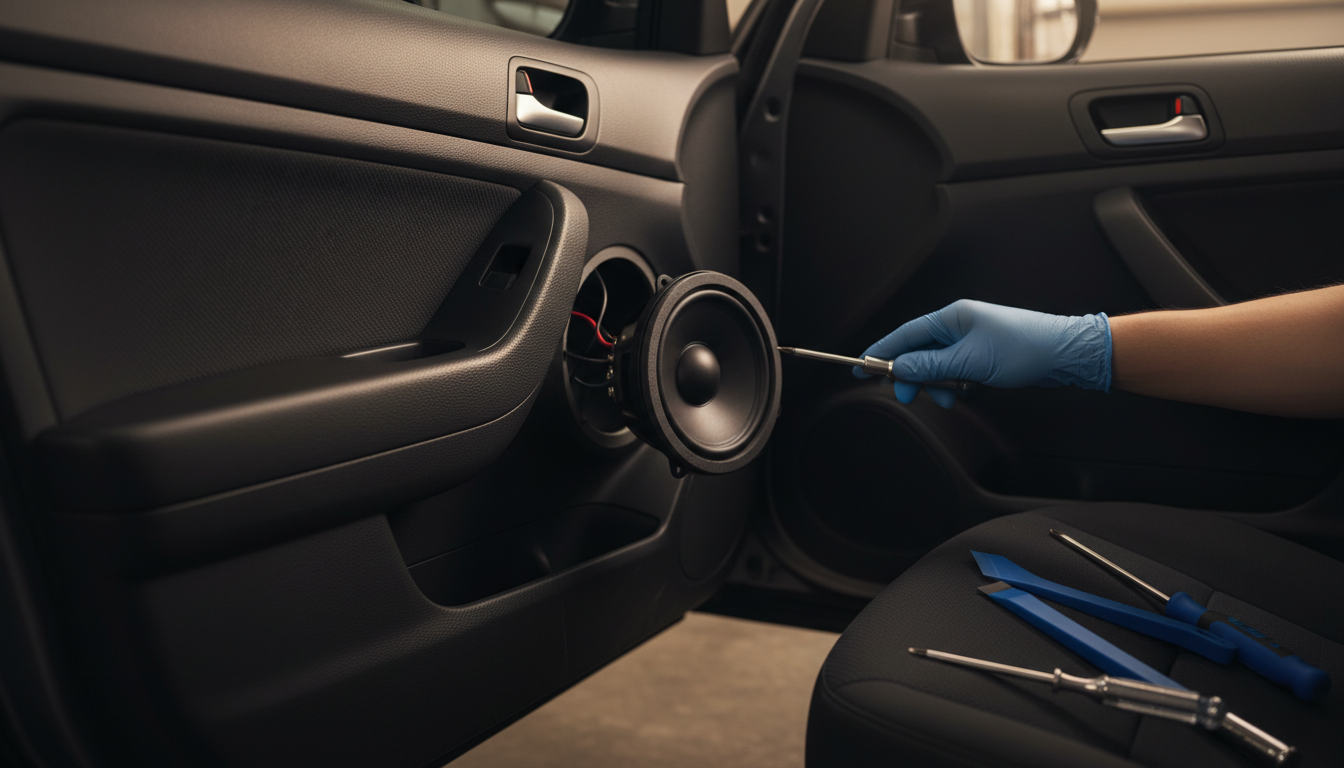
- Do it yourself (DIY): Coaxial speakers usually take one to two hours with basic tools, a panel removal kit, and a wiring adapter. Many retailers include vehicle-specific instructions.
- Independent shops: HomeGrail estimates $50 to $100 for a basic installation, though luxury vehicles with complex door panels cost more.
- Big-box retailers: Best Buy lists its component speaker installation at $149.99, with hardware not included.
Some retailers bundle free or discounted installation with a speaker purchase during sales, so ask before you pay full price for labor.
Pros and cons of upgrading car speakers
Pros
- Clearer vocals and tighter bass, even with a factory stereo
- One of the cheapest car audio upgrades
- Coaxial models install without custom work
- Frequent deep discounts during holiday sales
Cons
- Powerful speakers need an amplifier to shine
- Component sets add installation cost and complexity
- Cars with premium branded audio systems may need special adapters
Popular car speakers worth watching for deals
Amazon is our main affiliate partner, and it carries all of these well-reviewed 6.5-inch speakers. Specs come from manufacturer and retailer listings, including Crutchfield and World Wide Stereo.
Compare similar car speakers on Amazon
| Speaker (6.5-inch pair) | Type | RMS power | Sensitivity | Best for | Shop |
|---|---|---|---|---|---|
| JBL Club 64 | 2-way coaxial, 3 ohms | 60 watts | 93 dB | Factory stereos | Check price |
| Infinity Reference REF-6532ex | 2-way coaxial, 3 ohms | 55 watts | 93 dB | Shallow doors, low power | Check price |
| Kicker CS Series 46CSC654 | 2-way coaxial | 100 watts | 90 dB | Amplified systems | Check price |
| Pioneer A-Series TS-A653FH | 2-way coaxial, 4 ohms | 75 watts | 91 dB | Balanced all-rounder | Check price |
| Rockford Fosgate Prime R165X3 | 3-way coaxial, 4 ohms | 45 watts | 91 dB | Tightest budgets | Check price |
- JBL Club 64: High sensitivity and a 3-ohm design make it play loud on a factory head unit. World Wide Stereo lists it at $139.95, often on sale near $110. See the JBL Club 64 on Amazon.
- Kicker 46CSC654: It handles 100 watts RMS, so it’s a smart pick if you plan to add an amplifier. See the Kicker CS Series on Amazon.
- Rockford Fosgate R165X3: A long-running budget favorite that comes ready to install with grilles and hardware. See the Rockford Fosgate Prime on Amazon.
Planning a bigger upgrade? A compact amplifier such as a 4-channel car amplifier and a speaker wiring harness adapter for your vehicle make installation cleaner.
Who should upgrade their car speakers?
Upgrade if your factory speakers sound flat, distort at moderate volume, or have blown. Drivers who listen to music or podcasts on long commutes notice the biggest difference. If your car has a premium branded system with a factory amplifier, check fit guides first, since some systems use unusual impedances. Car audio gear also makes a practical present; see our best gifts for Dad under $100 for more ideas.
Frequently asked questions
When is the best time to buy car speakers?
The best time to buy car speakers is Black Friday week (November 27 to 30, 2026) or Amazon Prime Day, which usually bring the lowest prices, often 20% to 40% off.
Do I need an amplifier for new car speakers?
You don’t need an amplifier for new car speakers if they’re efficient models rated 90 dB or higher. High-power speakers need an amplifier to reach their potential.
Are 3-way speakers better than 2-way speakers?
No, 3-way speakers aren’t necessarily better than 2-way speakers. A well-made 2-way speaker often sounds smoother than a cheap 3-way or 4-way design.
Can I install car speakers myself?
Yes, you can install car speakers yourself. Coaxial speakers usually take an afternoon with basic tools, a trim removal kit, and the right brackets and wiring adapters.
Final verdict
The best deals on car speakers come from buying the right size, prioritizing sensitivity over flashy wattage, and shopping during Black Friday, Prime Day, or model clearances. Open-box units and do-it-yourself installation stretch your budget further. For most factory stereos, an efficient 6.5-inch coaxial pair is the smartest buy. Check the current JBL Club 64 price on Amazon, or compare the Infinity Reference REF-6532ex if you need a shallower fit.