
Home Tech Land is reader-supported. When you buy through links on our site, we may earn a commission. As an Amazon Associate, we earn from qualifying purchases.
Last updated: . How we research: We compare manufacturer specs with published lab measurements and owner reports; we don’t test products in person. Learn more about Home Tech Land.
The Samsung S95B was Samsung’s first organic light-emitting diode (OLED) TV in nearly a decade, and in 2026 it still delivers a stunning picture for movies and games at a used or open-box price. In 2022 it shared the honor of being one of the first quantum dot OLED (QD-OLED) TVs on sale, alongside Sony’s A95K. It paired a Samsung Display panel with four full-speed gaming ports and a price well below Sony’s. This Samsung S95B review explains how QD-OLED works, what reviewers measured, where the S95B falls short, and whether a used or open-box unit still makes sense now that the 2026 S95H leads Samsung’s range.
Quick verdict: The S95B delivers perfect blacks, exceptionally vivid color, bright high dynamic range (HDR) highlights for its era, and some of the best gaming features of any 2022 TV. It lacks Dolby Vision, its built-in sound is thin, and its blacks look slightly gray in bright rooms. At a used or open-box price, it’s still a stunning picture for movies and games. Check the Samsung S95B price on Amazon.
Key takeaways
- What it is: Samsung’s 2022 4K QD-OLED TV with a 120Hz panel, sold in 55 inches ($2,199.99 at launch) and 65 inches ($2,999.99 at launch).
- Who it’s for: Gamers with several consoles or a PC who watch mostly in a room they can dim, since all four High-Definition Multimedia Interface (HDMI) 2.1 ports support 4K at 120Hz.
- Price: Samsung has discontinued it. Even before it left stores, What Hi-Fi reported a 65-inch deal for under $1,600, so used and open-box units should cost well below that (fall 2026). Prices change often.
- Main weaknesses: No Dolby Vision, thin sound with weak bass, and blacks that look slightly gray in bright rooms.
- Successor: The 2026 Samsung S95H, which TechRadar measured at about 2,750 nits on a 10% HDR window, launched at $3,299 for 65 inches.
Samsung S95B at a glance
| Spec | Samsung S95B |
|---|---|
| Release | Spring 2022; discontinued and replaced by the S95C in 2023 |
| Sizes and launch prices | 55 inches ($2,199.99) and 65 inches ($2,999.99) |
| Panel | First-generation 4K QD-OLED from Samsung Display, 120 hertz (Hz) |
| Measured HDR peak brightness | 1,415 nits on a 5% window and 962 nits on a 10% window, per Trusted Reviews |
| HDR formats | HDR10, HDR10+, and Hybrid Log-Gamma (HLG); no Dolby Vision |
| Inputs | Four High-Definition Multimedia Interface (HDMI) 2.1 ports at 48 gigabits per second, one with enhanced audio return channel (eARC); two Universal Serial Bus (USB) ports |
| Gaming | 4K at 120Hz, variable refresh rate (VRR) with AMD FreeSync Premium, auto low-latency mode (ALLM), and about 9 to 10 milliseconds (ms) of input lag |
| Sound | Object Tracking Sound with Dolby Atmos; Samsung lists a 60-watt, 2.2.2-channel system for US models |
| Smart platform | Tizen with Bixby and Amazon Alexa built in, plus Google Assistant support |
| Processor | Neural Quantum Processor 4K |
Specs and measurements come from TechHive’s launch report, Trusted Reviews, and What Hi-Fi.
How QD-OLED works
Most OLED TVs, like the LG B2, use white OLED (W-OLED) subpixels with color filters on top. Those filters block some light, which limits how bright saturated colors can get. In a QD-OLED panel, every pixel emits blue light, and a layer of quantum dots converts part of it into pure red and green. Little light goes to waste, so colors stay rich even in very bright scenes.
Each of the screen’s roughly 8.3 million pixels turns on and off by itself, so the S95B shows true black and never suffers the blooming that liquid crystal display (LCD) TVs with local dimming can show around bright objects. Sony’s A95K used the same first-generation panel, but Samsung handled the processing, ports, and design differently.
Design
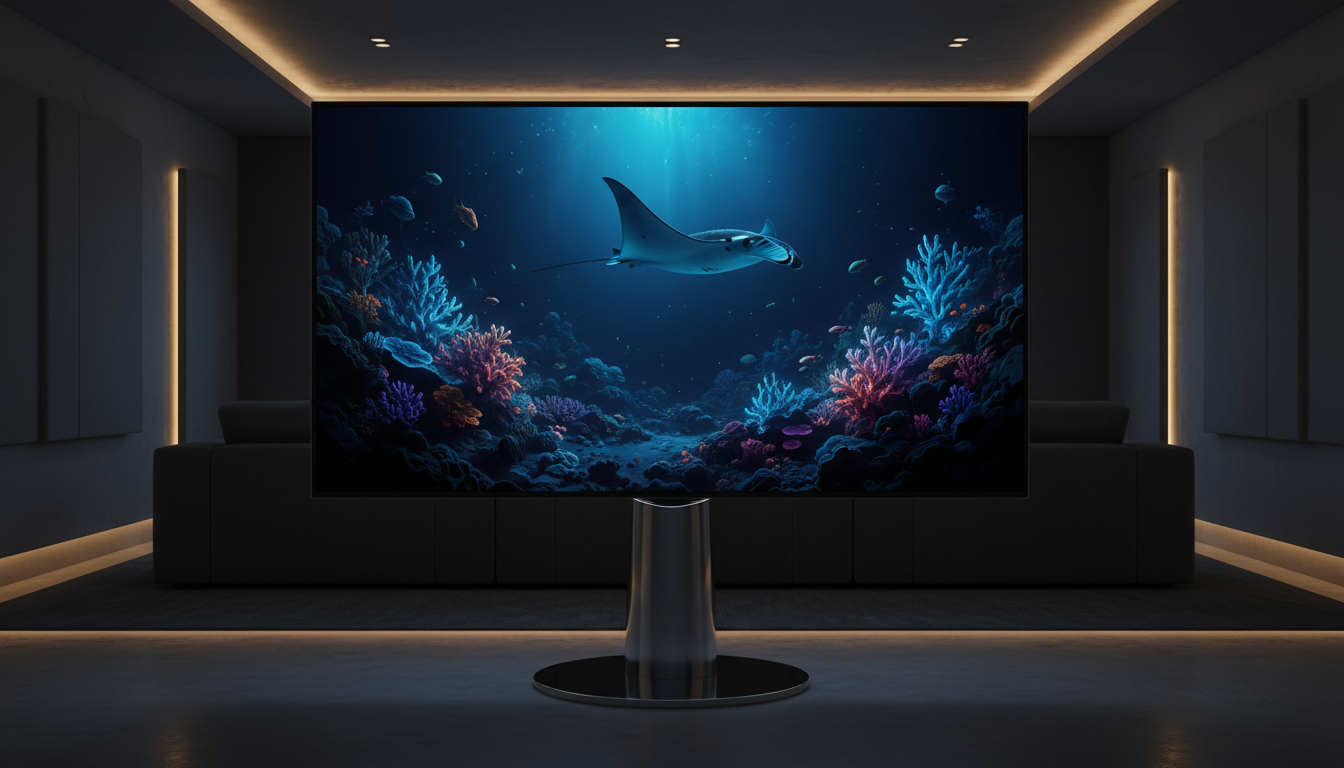
The S95B’s panel measures only a few millimeters thick across most of its back, with a deeper section at the bottom that holds the electronics and ports. What Hi-Fi lists a depth of about 1.6 inches without the stand. A heavy central pedestal stand supports the TV, so it fits on narrower furniture than sets with feet at the edges. What Hi-Fi recommends a second person for setup because the panel is so thin. Samsung included its rechargeable SolarCell remote, which charges from indoor light or a USB Type-C (USB-C) cable.
Picture quality
Color
Color is the S95B’s headline strength. Reviewers praised how saturated and vibrant bright, colorful scenes looked, such as nature documentaries, animation, and sunlit landscapes. What Hi-Fi gave the picture five stars but noted imperfect skin tones and recommended tweaking settings, since the default modes push color hard.
Brightness and HDR
Trusted Reviews measured 1,415 nits on a small 5% window, far brighter than most 2022 OLEDs, and What Hi-Fi found it brighter than both the Sony A95K and LG’s G2 in highlights and full-screen scenes. Some reviewers noticed brightness shifting slightly in mixed scenes as the TV managed power. The lack of Dolby Vision means Netflix, Disney+, and Apple TV+ content plays in HDR10 instead, though Samsung’s tone mapping handles it well.
Black levels in bright rooms
In a dark room, blacks look perfect. QD-OLED panels skip the polarizer layer that W-OLED screens use, though, so strong ambient light can make black areas look slightly gray. Samsung fixed this in 2024 with the S95D’s anti-glare matte screen, which its successors still use.
Viewing angles and burn-in
Viewing angles are excellent, so everyone on a wide sofa sees the same picture. Like any OLED, the S95B can develop burn-in from static logos or game interfaces shown for hours a day. Samsung includes pixel shift and logo-dimming tools, but if you watch the same news channel all day, a Mini light-emitting diode (Mini LED) TV is the safer choice.
Gaming performance
The S95B excels for gaming. All four HDMI ports support full 48 gigabits per second bandwidth, so you can connect a PlayStation 5 (PS5), an Xbox Series X, and a gaming PC at 4K and 120Hz without giving up the eARC port. Trusted Reviews measured 9.6ms of input lag, and What Hi-Fi recorded 9ms, both excellent. VRR works with AMD FreeSync Premium and with Nvidia G-Sync, though G-Sync wasn’t officially certified. Samsung’s Game Bar shows frame rate and VRR status at a glance, and Samsung Gaming Hub adds cloud gaming services such as Xbox Cloud Gaming. RTINGS found that forcing 144Hz didn’t work well on its unit, so treat 120Hz as the limit. See our guide to the best gaming TVs for PS5 and Xbox for current options.
Smart features and sound
Tizen gives you all the major streaming apps, Samsung TV Plus free channels, Multi View for watching two sources at once, and Ambient Mode for displaying art or photos. What Hi-Fi found the interface cluttered and slow to start, a common complaint about Samsung’s 2022 software. You can also control the TV with Bixby, Alexa, or Google Assistant.
Sound is the S95B’s weakest area. Object Tracking Sound moves audio around the screen to follow the action, but What Hi-Fi rated sound three out of five, citing weak bass and crackling at high volume. A soundbar makes a big difference, and Samsung’s Q-Symphony feature lets compatible Samsung soundbars play together with the TV’s speakers. Our Samsung HW-Q990B review covers Samsung’s 2022 flagship, or browse Samsung Dolby Atmos soundbars on Amazon.
Pros and cons
Pros
- Perfect blacks and extremely vivid color
- Bright HDR highlights for a 2022 OLED
- Four full-bandwidth HDMI 2.1 ports
- Very low input lag and strong VRR support
- Wide viewing angles
- Slim design with a compact pedestal stand
Cons
- No Dolby Vision
- Thin sound with weak bass
- Blacks look slightly gray in bright rooms
- Default picture modes need tweaking
- Burn-in risk with heavy static content
- Discontinued
Is the Samsung S95B discontinued?
Yes. Samsung replaced it with a new flagship QD-OLED every year:
- S95C (2023): Added a 77-inch size, a 144Hz refresh rate, a brighter panel, and the external One Connect Box for cables.
- S95D (2024): Introduced Samsung’s anti-glare matte OLED screen, which fixed the S95B’s bright-room black levels.
- S95F (2025): Raised brightness again and pushed the refresh rate to 165Hz.
- S95H (2026): The current flagship. TechRadar measured about 2,750 nits on a 10% HDR window, nearly three times the S95B’s 10% result, and it comes in 55, 65, 77, and 83 inches. It launched at $3,299 for 65 inches, drops the One Connect Box for rear ports, and adds a divisive silver frame.
Even before it left stores, What Hi-Fi reported a 65-inch S95B deal for under $1,600 through Woot, so used and open-box units today should cost well below that.
Samsung S95B vs. current OLED TVs
Amazon is our main affiliate partner, and it carries the S95B’s successors and today’s strongest OLED alternatives. Prices change often, so check current deals.
Compare similar OLED TVs on Amazon
| TV | Panel | Max refresh rate | Best for | Shop |
|---|---|---|---|---|
| Samsung S95B (2022) | QD-OLED (first gen) | 120Hz | Gaming and movies on a used budget | Check price |
| Samsung S95H (2026) | QD-OLED with anti-glare screen | 165Hz | The brightest Samsung OLED for bright rooms | Check price |
| Samsung S95F (2025) | QD-OLED with anti-glare screen | 165Hz | Flagship picture at a clearance price | Check price |
| Samsung S90F (2025) | QD-OLED or W-OLED, by size | 144Hz | Premium OLED for less | Check price |
| Sony A95K (2022) | QD-OLED (first gen) | 120Hz | Movie fans who want Dolby Vision | Check price |
| LG C5 (2025) | W-OLED | 144Hz | Dolby Vision and all-round gaming | Check price |
- Samsung S95H: It solves every S95B weakness except Dolby Vision, with far more brightness and an anti-glare screen. See the Samsung S95H on Amazon.
- Samsung S90F: Our Samsung S90F review explains why it’s the value pick in Samsung’s OLED range. See the Samsung S90F on Amazon.
- Sony A95K: The S95B’s first-generation QD-OLED twin offers Dolby Vision, better processing, and superb sound, but only two HDMI 2.1 ports. See the Sony A95K on Amazon.
- LG C5: A popular all-rounder with Dolby Vision and four HDMI 2.1 ports. See the LG C5 on Amazon.
Who should buy the Samsung S95B?
Buy the S95B if you find a well-kept used or open-box unit for far less than a new S90F, you game on several consoles or a PC, and you watch mostly in a room you can dim. Check for burn-in on a gray screen, confirm the remote and stand come with it, and plan on adding a soundbar. Skip it if you rely on Dolby Vision, watch in a sunny room, or want a warranty. A slim TV wall mount shows off its thin profile.
Frequently asked questions
Does the Samsung S95B support Dolby Vision?
No, the Samsung S95B doesn’t support Dolby Vision. Samsung doesn’t support Dolby Vision on any of its TVs. The S95B uses HDR10+ instead, along with HDR10 and HLG.
Is the Samsung S95B good for gaming?
Yes, the Samsung S95B is good for gaming. It offers four full-bandwidth HDMI 2.1 ports, 4K at 120Hz, VRR, ALLM, and about 9 to 10ms of input lag.
What replaced the Samsung S95B?
The S95C replaced the Samsung S95B in 2023, followed by the S95D, S95F, and the current 2026 S95H.
Is the Samsung S95B still worth buying?
The Samsung S95B is worth buying only at a strong used or open-box price. Its picture still impresses, but newer QD-OLEDs are much brighter and handle bright rooms better.
Final verdict
The Samsung S95B made a remarkable debut for QD-OLED, with perfect blacks, dazzling color, bright highlights, and gaming features that beat most rivals of its time. Missing Dolby Vision, thin sound, and grayish blacks in bright rooms kept it from perfection, and the S95D through S95H have fixed most of those issues. At a used price, it remains a beautiful TV for movies and games. Check the current Samsung S95B price on Amazon, or compare the Samsung S95H on Amazon.