
Home Tech Land is reader-supported. When you buy through links on our site, we may earn a commission. As an Amazon Associate, we earn from qualifying purchases.
Last updated: . How we research: We compare manufacturer specs with published lab measurements and owner reports; we don’t test products in person. Learn more about Home Tech Land.
The Samsung QN85A is a 2021 4K TV with a Mini light-emitting diode (LED) backlight and quantum-dot color, sold as a Neo QLED (quantum-dot LED), and in 2026 it’s a good buy only at a deep open-box or used discount. It gets very bright, handles reflections and wide seating well, and supports 4K at 120Hz for gaming, but it skips Dolby Vision and offers just one High-Definition Multimedia Interface (HDMI) 2.1 port. Samsung replaced it several times, so this Samsung QN85A review explains what reviewers found, how it compares with the QN90A, and which current Samsung Neo QLED TVs take its place.
Quick verdict: The QN85A delivers bright, colorful high dynamic range (HDR) pictures, wide viewing angles, a slim design, and Samsung’s polished Tizen smart platform. Its in-plane switching (IPS) style panel gives up contrast compared with the QN90A, and weak speakers, mediocre upscaling, and the single full-speed gaming port hold it back. Buy it for a bright living room at a clearance price, or pick a 2026 QN80H for more gaming flexibility. Check the Samsung QN85A price on Amazon.
Key takeaways
- What it is: Samsung’s 2021 midrange Neo QLED TV, sold in 55-, 65-, 75-, and 85-inch sizes, with Mini LED local dimming and quantum dots.
- Price: It launched at $1,599.99 for the 55-inch and up to $4,449.99 for the 85-inch. As of November 2026, it sells mainly as open-box or used stock, and prices change often.
- Main strength: High brightness (about 1,500 nits claimed and 1,157 nits sustained in Reviewed’s lab) plus wide viewing angles.
- Main weaknesses: No Dolby Vision, only one HDMI 2.1 port, weaker contrast than the QN90A, and thin built-in sound.
- Successor: The 2026 QN80H Neo QLED starts at $1,299.99 for 55 inches and adds a 144Hz panel.
Samsung QN85A at a glance
| Spec | Samsung QN85A (2021) |
|---|---|
| Sizes | 55, 65, 75, and 85 inches |
| Launch price | $1,599.99 (55-inch), $2,199.99 (65-inch), $2,999.99 (75-inch), $4,449.99 (85-inch) |
| Panel and backlight | IPS-type liquid crystal display (LCD) with quantum dots and a Mini LED backlight |
| Local dimming | More than 500 zones on the 55-inch, per T3 |
| Peak HDR brightness | About 1,500 nits claimed; 1,157 nits sustained on a 50% window in Reviewed’s lab |
| Color gamut | 95.7% Digital Cinema Initiatives P3 (DCI-P3), per Reviewed |
| Refresh rate | 120Hz native |
| HDMI | Four ports: one HDMI 2.1 with 4K at 120Hz, three HDMI 2.0b; enhanced Audio Return Channel (eARC) on one port |
| HDR formats | HDR10, HDR10+, and Hybrid Log-Gamma (HLG); no Dolby Vision |
| Gaming | Variable refresh rate (VRR), auto low latency mode (ALLM), and AMD FreeSync Premium Pro |
| Processor and platform | Neo Quantum Processor 4K, Tizen with Alexa, Google Assistant, and Bixby |
Specs come from Reviewed’s QN85A review, TechRadar’s QN85A review, and T3’s QN85A review.
Design
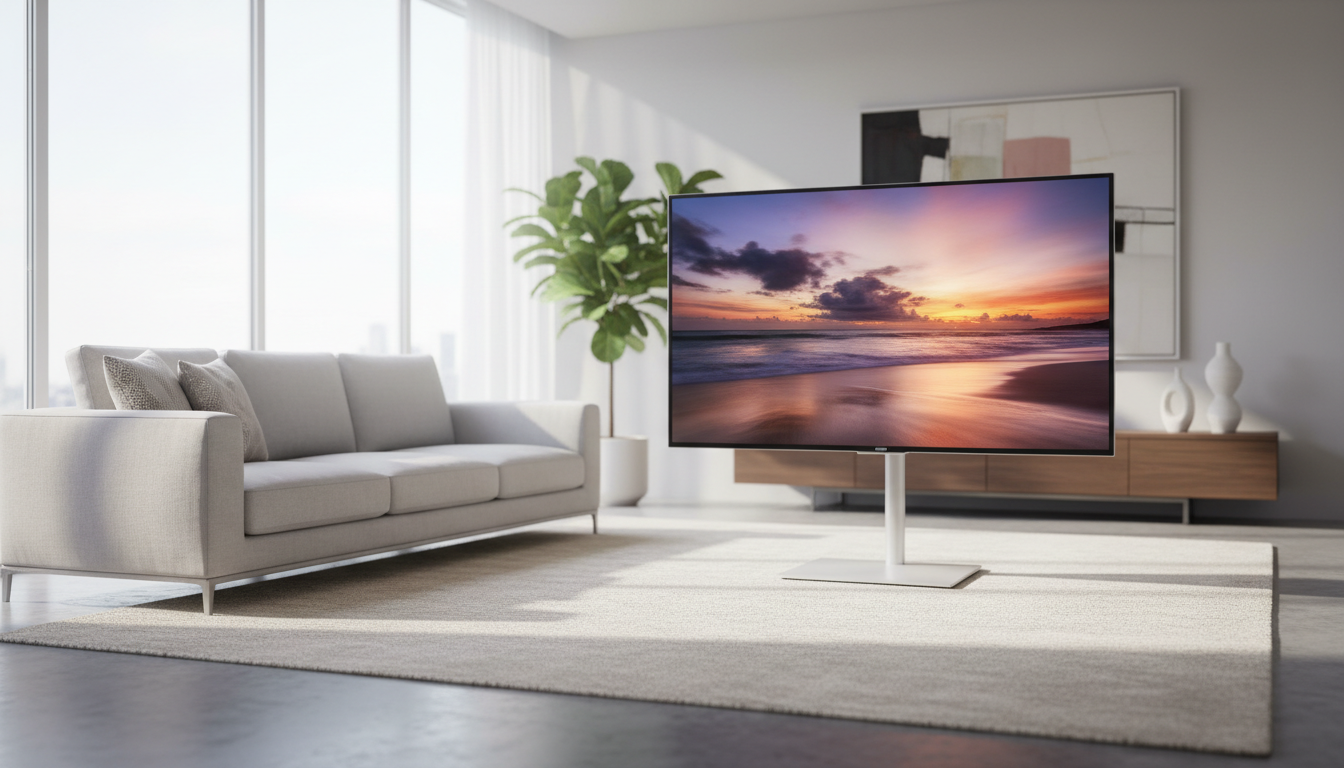
Mini LEDs let Samsung build a slimmer cabinet than its older full-array QLEDs, and T3’s QN85A review and Trusted Reviews both praised the QN85A’s slim, elegant chassis. Narrow bezels keep attention on the picture. Samsung moved the processing and inputs into the TV itself rather than an external One Connect box.
For wall mounting, our guide to the best TV wall mounts for 65-inch TVs covers brackets for the 55- to 75-inch sizes. A low-profile wall mount from Amazon shows off the thin design.
Picture quality
Brightness and HDR
Brightness is the QN85A’s headline strength. Samsung and reviewers cite a peak of about 1,500 nits, and Reviewed’s QN85A review measured about 1,157 nits sustained on a 50% window, with roughly 900 to 1,100 nits in typical HDR content. That’s enough to keep HDR highlights punchy and fight glare in a sunny room. HDR10+ support adds scene-by-scene tone mapping, but the QN85A doesn’t support Dolby Vision, which matters if you stream a lot of Netflix, Disney+, or Apple TV+ content.
Contrast and the IPS panel
The QN85A’s biggest tradeoff comes from its panel. Reviewers found that the tested 55-inch model uses an IPS-type panel, which RTINGS calls an Advanced Super Dimension Switch (ADS) panel, rather than the vertical alignment (VA) panel in the step-up QN90A. RTINGS’ QN85A vs. QN90A comparison says the QN90A has a much higher contrast ratio and deeper blacks, while the QN85A offers wider viewing angles. Reviewed noted it couldn’t confirm which sizes use which panel type, so panel behavior may differ by size.
Reviews split on how much that matters. Reviewed’s QN85A review called the black levels abysmal in its lab tests and recommended the QN90A for contrast, while TechRadar’s QN85A review praised excellent black levels for an LCD TV. The Mini LED dimming does much of the work: it darkens zones behind black areas, but in a dark room you’ll see grayer blacks and some blooming. Our explainer on how local dimming works covers why the panel and zone count both matter.
Color, viewing angles, and upscaling
Quantum dots give the QN85A rich, saturated color, with 95.7% DCI-P3 coverage for HDR and 99.8% of the International Telecommunication Union Recommendation 709 (Rec. 709) standard for regular content in Reviewed’s tests. The IPS-type panel keeps color and brightness steady from off-center seats, which suits wide sofas. T3 warned that this panel type tends to look more reflective. TechRadar found upscaling of low-resolution content weaker than expected, and Trusted Reviews and T3 both noted occasional motion-handling problems.
Gaming
The QN85A supports 4K at 120Hz, VRR, ALLM, and AMD FreeSync Premium Pro, so a PlayStation 5 (PS5), Xbox Series X, or gaming PC can use their high frame rate modes. The catch: only one of the four HDMI ports offers HDMI 2.1 speeds. If you own two current consoles, one of them drops to 4K at 60Hz unless you swap cables, and T3 listed the single HDMI 2.1 port as a key drawback.
Samsung’s Game Bar overlay shows frame rate and VRR status, and Game Mode keeps input lag low. For more options, see our guide to the best gaming TVs for PS5 and Xbox.
Smart features and sound
The QN85A runs Samsung’s Tizen platform, which TechRadar and Trusted Reviews both called outstanding for its speed and layout. It includes Samsung TV Plus free channels, Alexa, Google Assistant, and Bixby voice control, and SmartThings for smart home devices. Samsung has since moved newer TVs to updated Tizen versions, and a 2021 model won’t get every new feature.
Sound is the weak spot. The four-driver, 60-watt system supports Object Tracking Sound (OTS) and Samsung’s Q-Symphony, which lets the TV speakers work together with a compatible Samsung soundbar. TechRadar called the audio underwhelming, and every major review recommended a soundbar. A Samsung Q-Symphony soundbar from Amazon pairs well, and our Samsung HW-Q990B review covers a high-end option.
Pros and cons
Pros
- Very bright HDR with about 1,500 nits claimed
- Wide viewing angles from the IPS-type panel
- 4K at 120Hz, VRR, and FreeSync Premium Pro on one port
- Slim design and a fast Tizen interface
- HDR10+ support and rich quantum-dot color
Cons
- No Dolby Vision support
- Only one HDMI 2.1 port
- Weaker contrast and grayer blacks than the QN90A
- Underwhelming built-in sound
- Weak upscaling and occasional motion issues
Samsung QN85A vs. QN90A
The QN90A was Samsung’s step-up 2021 Neo QLED. It uses a VA panel with much deeper blacks and higher contrast, and it gets slightly brighter, according to RTINGS’ QN85A vs. QN90A comparison. The QN85A cost less and wins on viewing angles. Pick the QN85A for a bright room with wide seating, and the QN90A for movie nights in the dark. For a later flagship, read our Samsung QN90C review.
What replaced the Samsung QN85A?
Samsung kept the QN85 name through four more generations: the QN85B (2022), QN85C (2023), QN85D (2024), and QN85F (2025). Each kept Mini LED dimming and quantum dots and refined brightness, processing, and gaming features.
For 2026, Samsung reorganized its lineup. According to TechRadar’s report on Samsung’s 2026 lineup, the Neo QLED range now includes the QN80H ($1,299.99 to $5,499.99 at launch, with a 144Hz panel) and the cheaper QN70H ($599.99 to $2,299.99). Below them, the new M80H and M70H Mini LED models drop quantum dots entirely. Our Samsung Q80B review covers a non-Mini LED 2022 alternative that still turns up on sale.
Samsung QN85A vs. current Mini LED TVs
Amazon is our main affiliate partner, and it carries the QN85A’s successors and its strongest Mini LED rivals in 55- to 85-inch sizes. Prices change often, so check current deals before you buy.
Compare similar Mini LED TVs on Amazon
| TV | Backlight | Max refresh rate | Dolby Vision | Best for | Shop |
|---|---|---|---|---|---|
| Samsung QN85A (2021) | Mini LED, quantum dots | 120Hz | No | Open-box value in bright rooms | Check price |
| Samsung QN80H (2026) | Mini LED (Neo QLED), quantum dots | 144Hz | No | Samsung’s newest Neo QLED | Check price |
| Samsung QN90F (2025) | Mini LED with Glare-Free screen | Up to 165Hz | No | Bright rooms at a clearance price | Check price |
| TCL QM7L (2026) | Mini LED, quantum dots | 144Hz | Yes | Best midrange picture for the money | Check price |
| Hisense U7SG (2026) | Mini LED, quantum dots | 165Hz | Yes | Multi-console gaming | Check price |
- Samsung QN80H: The QN85A’s closest modern replacement adds four HDMI ports and a 144Hz panel. See the QN80H on Amazon.
- TCL QM7L: It adds Dolby Vision and bright Mini LED HDR for less than a QN80H. See the TCL QM7L on Amazon.
- Hisense U7SG: Four HDMI 2.1 ports fix the QN85A’s biggest gaming limit. See the U7SG on Amazon.
Who should buy the Samsung QN85A?
Buy an open-box or used QN85A if you watch in a bright room, sit at wide angles, own one current console, and prefer Samsung’s Tizen interface. Skip it if you watch mostly in the dark, want Dolby Vision, or need two or more HDMI 2.1 ports. In those cases, a QN80H, TCL QM7L, or Hisense U7SG makes more sense in 2026.
Frequently asked questions
Is the Samsung QN85A a Mini LED TV?
Yes, the Samsung QN85A is a Mini LED TV. Samsung sells it as a Neo QLED, which pairs a Mini LED backlight with local dimming and a quantum-dot color layer.
Does the Samsung QN85A support Dolby Vision?
No, the Samsung QN85A doesn’t support Dolby Vision. It supports HDR10, HDR10+, and HLG, and Samsung still doesn’t offer Dolby Vision on its TVs.
Does the Samsung QN85A have HDMI 2.1?
Yes, the Samsung QN85A has one HDMI 2.1 port. That port supports 4K at 120Hz, VRR, and ALLM, while the other three HDMI ports top out at 4K at 60Hz.
Is the QN85A or QN90A better?
The Samsung QN90A is better for picture quality, especially in dark rooms. Its VA panel delivers much deeper blacks and higher contrast, while the QN85A’s IPS-type panel offers wider viewing angles for less money.
Final verdict
The Samsung QN85A brought Mini LED brightness to a lower price in 2021, and its bright HDR, wide viewing angles, and slim design still hold up. Grayer blacks than the QN90A, no Dolby Vision, a single HDMI 2.1 port, and weak speakers limit its appeal in 2026. Buy it only at a steep open-box discount, or step up to a QN80H or TCL QM7L. Check the current Samsung QN85A price on Amazon.