
Home Tech Land is reader-supported. When you buy through links on our site, we may earn a commission. As an Amazon Associate, we earn from qualifying purchases.
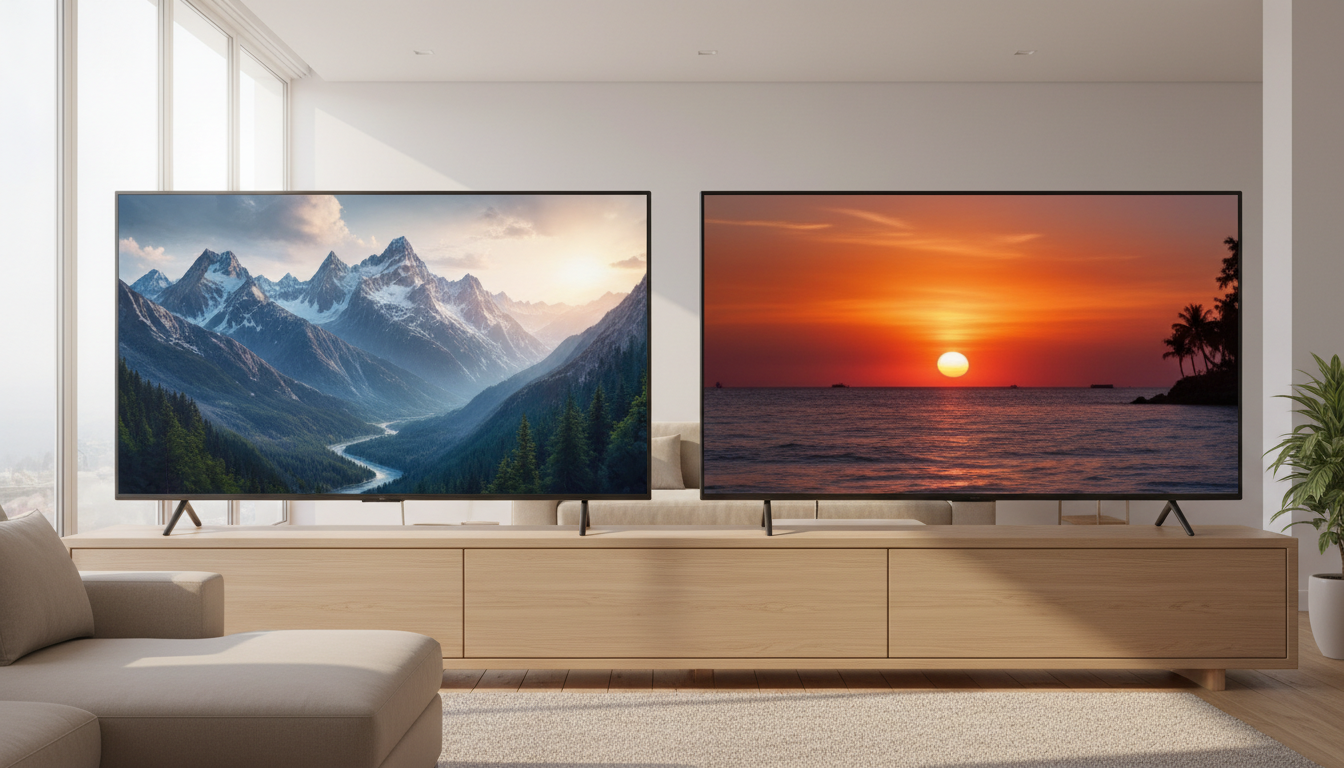
If you searched for the TCL 5 Series vs. the Hisense U6 Series, you’re looking at a matchup that no longer exists in that form. TCL retired the 5 Series name in 2023, and Hisense has replaced the U6 several times since then. The rivalry itself is alive and well, though. This TCL vs Hisense guide for 2026 explains which current models replaced those two TVs, how the brands compare at each price tier, and which one makes more sense for your room, your games, and your budget.
Quick verdict: In the budget Mini light-emitting diode (Mini-LED) tier, Hisense usually wins on brightness and features, while TCL counters with Google TV and a slimmer design. In the midrange, TCL’s QM7L edges ahead on color and picture quality, while Hisense’s U7SG offers more High-Definition Multimedia Interface (HDMI) 2.1 ports and a 165Hz panel. Check the TCL QM7L price on Amazon or check the Hisense U7SG price on Amazon.
What happened to the TCL 5 Series and Hisense U6?
The TCL 5 Series was TCL’s step-up quantum-dot light-emitting diode (QLED) line from about 2020 through 2022. The last versions, the S546 (Google TV) and S555 (Roku TV), paired quantum-dot color with a modest number of local dimming zones. In 2023, TCL reorganized its lineup into the S Class (value) and Q Class (premium) families, and the 5 Series slot went to the Q6 and Q7. Since 2025, TCL has used model codes like Q65, QM6K, QM7K, and QM8K, where “QM” marks a Mini-LED backlight and the final letter marks the model year (K for 2025, L for 2026).
Hisense kept the U6 name, but the TV underneath keeps changing. The 2023 U6K added a Mini-LED backlight, the 2024 U6N followed, the 2025 U6 sold on Amazon as the U65QF, and the 2026 U6 arrived as the U6SF and the brighter U6SF Pro. Today’s U6 is a far better TV than the U6K the original matchup covered.
How the old models map to the current lineups
| Tier | Old matchup | Current TCL model | Current Hisense model |
|---|---|---|---|
| Budget QLED (no Mini-LED) | TCL 4 Series vs. Hisense A6 (basic LED sets) | TCL Q65 (Q Series QLED) | Hisense QD6 |
| Budget Mini-LED | TCL 5 Series vs. Hisense U6K | TCL QM6K (2025) | Hisense U6SF / U6SF Pro (2026), U65QF (2025) |
| Midrange Mini-LED | TCL 6 Series vs. Hisense U7 | TCL QM7L (2026), QM7K (2025) | Hisense U7SG / U7SF (2026) |
| Premium Mini-LED | TCL QM8 vs. Hisense U8 | TCL QM8L (2026) | Hisense U8 Series |
TCL and Hisense often keep last year’s models on sale for months after the new ones launch, so the 2025 QM6K and U65QF still offer some of the best value in 2026, especially when they hit clearance prices.
Fixing the old comparison
The original TCL 5 Series vs. Hisense U6 comparison circulated a few claims worth correcting:
- Neither TV had a native 120Hz panel. Reviewed found the TCL S555 ran at a native 60Hz, and Tom’s Guide confirmed the same for the Hisense U6K. Both supported variable refresh rate (VRR) only up to 60Hz.
- The 5 Series didn’t always run Google TV. The 2021 S546 used Google TV, but the 2022 S555 shipped with Roku TV only.
- The U6K lacked HDMI 2.1. Its inputs were HDMI 2.0, while the S555 offered HDMI 2.1 ports limited to 60Hz.
The good news: every current Mini-LED TV in this guide supports a native 144Hz or higher refresh rate, so today’s budget sets are genuine gaming TVs.
Budget Mini-LED: TCL QM6K vs. Hisense U6
This tier is the true successor to the 5 Series vs. U6 battle. Both TVs offer 4K resolution, Mini-LED backlights with full-array local dimming, quantum-dot color, a native 144Hz refresh rate, and support for Dolby Vision, HDR10+, HDR10, and Hybrid Log-Gamma (HLG) high dynamic range (HDR) formats.
In Tom’s Guide’s U65QF vs. QM6K comparison, the 65-inch Hisense U65QF measured 968 nits in HDR at a 10% window, compared with 695 nits for the TCL QM6K, and it handled glare better. Color accuracy and input lag came out nearly identical (about 13 milliseconds on both). The Hisense also added an Advanced Television Systems Committee (ATSC) 3.0 tuner for NextGen TV broadcasts and Wi-Fi 6, while the TCL is slimmer and lighter. Tom’s Guide picked the Hisense overall, scoring it 90 to the TCL’s 83.
The 2026 U6SF Pro widens the gap on paper. In Tom’s Guide’s Hisense U6SF Pro review, it measured about 1,265 nits in HDR, covered 96% of the Digital Cinema Initiatives (DCI-P3) color space, posted 9.3 milliseconds of input lag, and earned an Editor’s Choice award. The standard U6SF costs less but runs dimmer, so check which version you’re buying. The main tradeoffs: Hisense’s U6 models run Fire TV rather than Google TV, and they offer only two HDMI 2.1 ports.
Pick the TCL QM6K if you prefer Google TV or want the slimmest, lightest set. Pick the Hisense U6 if your room gets a lot of daylight or you want ATSC 3.0 and the brightest picture for the money.
Midrange Mini-LED: TCL QM7L vs. Hisense U7SG
Step up to around $900 for a 65-inch, and the fight gets closer. Tom’s Guide’s U7SG vs. QM7L comparison measured 2,866 nits of HDR brightness on the Hisense U7SG versus 2,270 nits on the TCL QM7L, but the QM7L covered more of the wide International Telecommunication Union Recommendation 2020 (Rec. 2020) color space (90% vs. 83%) and showed slightly better color accuracy. Input lag landed under 10 milliseconds on both. The final score came out an 89-to-89 tie, with the reviewer recommending the QM7L for picture quality and the U7SG for ports and price.
The ports matter for gamers. The U7SG offers four HDMI 2.1 inputs and a 165Hz panel, while the QM7L runs 4K at 144Hz on only two of its four HDMI inputs, according to Digital Trends’ QM7L review. If you own a PlayStation 5, an Xbox Series X, and a gaming personal computer (PC), the Hisense can connect all three at full speed without a switch. Both run Google TV, and the U7 also comes as the U7SF with Fire TV.
TCL’s previous-generation QM7K remains a strong buy on clearance. We cover a close sibling, sold at warehouse clubs, in our TCL Q77K review.
Budget QLED: TCL Q65 vs. Hisense QD6
If you want a big screen for the least money and can live without Mini-LED or high refresh rates, TCL’s Q65 (Q Series QLED) and Hisense’s QD6 compete under $400 for a 65-inch. Both use quantum-dot color on a 60Hz panel, so they suit streaming and casual gaming more than competitive play. The QD6 runs Fire TV and supports Dolby Vision and HDR10+, and Best Buy sold the 65-inch for $299.99 earlier this year. The Q65 runs Google TV. For a step up at a similar size, see our list of the best 55-inch TVs under $500, where the budget Mini-LED models above also appear.
TCL vs Hisense: brand-level differences
Smart platform
TCL leans on Google TV across its lineup. Hisense splits its models between Google TV and Fire TV, and in 2026 the U6 runs Fire TV with Alexa+, while the U7 comes in both versions. Tom’s Guide praised Google TV for speed and search but noted that Fire TV includes cloud gaming apps such as Xbox Game Pass and GeForce Now.
Brightness and bright rooms
In head-to-head testing, Hisense sets have measured brighter in HDR at both the budget and midrange tiers. That makes Hisense the safer choice for sunny living rooms.
Color and picture processing
TCL’s 2026 sets use what the company calls Super Quantum Dot (SQD) technology, and reviewers credit the QM7L with wider color coverage and better shadow detail than its Hisense rival.
Sound
Both brands now add subwoofers or upgraded speaker systems, such as the U7’s 50-watt 2.1.2-channel system and TCL’s Bang & Olufsen tuning, yet reviewers still recommend a soundbar for movies. Browse soundbars under $300 on Amazon.
Compare TCL and Hisense TVs on Amazon
Amazon is our main affiliate partner, and it carries current and previous-year TCL and Hisense models in most sizes. Here’s how the matched pairs line up:
Compare similar TCL and Hisense TVs on Amazon
| TV | Tier | Backlight and refresh rate | Smart platform | Best for | Shop |
|---|---|---|---|---|---|
| TCL Q65 (Q Series QLED) | Budget | QLED, 60Hz | Google TV | Lowest-cost Google TV QLED | Check price |
| Hisense QD6 | Budget | QLED, 60Hz | Fire TV | Lowest-cost Fire TV QLED | Check price |
| TCL QM6K | Budget Mini-LED | Mini-LED, 144Hz | Google TV | Google TV fans on a budget | Check price |
| Hisense U6SF Pro | Budget Mini-LED | Mini-LED, 144Hz | Fire TV | Bright rooms on a budget | Check price |
| TCL QM7L | Midrange Mini-LED | Mini-LED, 144Hz | Google TV | Best color and picture quality | Check price |
| Hisense U7SG | Midrange Mini-LED | Mini-LED, 165Hz | Google TV | Gamers with several consoles | Check price |
- TCL QM6K: The 2025 budget Mini-LED model is often discounted heavily, making it a bargain Google TV pick. See the TCL QM6K on Amazon.
- Hisense U6SF Pro: Tom’s Guide’s Editor’s Choice delivers more than 1,200 nits of HDR brightness for budget money. See the Hisense U6SF Pro on Amazon.
- TCL QM7L: The midrange pick for movie fans who want rich color and strong HDR. See the TCL QM7L on Amazon.
- Hisense U7SG: Four full-speed HDMI 2.1 ports make it the gamer’s choice. See the Hisense U7SG on Amazon.
Which brand should you buy?
Choose TCL if:
- You want Google TV on every model
- Color accuracy and wide color coverage matter most to you
- You watch mostly in a dim or controlled room
- You want a thinner, lighter TV
Choose Hisense if:
- Your room gets a lot of daylight
- You want an ATSC 3.0 tuner for NextGen TV broadcasts
- You connect several consoles and need more HDMI 2.1 ports
- You prefer Fire TV and Alexa
Whichever brand you choose, a sturdy TV wall mount or a solid stand finishes the setup.
Frequently asked questions
Does TCL still make the 5 Series?
No. TCL dropped the 5 Series name in 2023. Its closest current equivalents are the budget Mini-LED QM6K and, for 2026, the QM7L one step up.
Is Hisense or TCL more reliable?
Both brands rank among the largest TV makers in the world and offer similar one-year warranties in the U.S. Neither has a clear reliability edge, so buy based on picture, features, and price, and consider a retailer’s extended warranty for large sets.
Which is better for gaming, TCL or Hisense?
At the budget tier, it’s close: both the QM6K and U6 offer 144Hz panels with similar input lag. In the midrange, the Hisense U7SG has the edge for multi-console setups thanks to four HDMI 2.1 ports and a 165Hz refresh rate.
What replaced the Hisense U6K?
The U6N replaced it in 2024, followed by the 2025 U6 (U65QF on Amazon) and the 2026 U6SF and U6SF Pro.
Final verdict
The TCL vs Hisense rivalry has moved well beyond the 5 Series and U6K. In 2026, Hisense wins the budget Mini-LED tier on brightness and features, while TCL’s QM7L takes the midrange for color and overall picture quality. Pick Hisense for bright rooms and multi-console gaming, and pick TCL for Google TV and richer color. Check the current TCL QM7L price on Amazon, or check the current Hisense U6SF Pro price on Amazon.
2 thoughts on “TCL vs Hisense (2026): What Replaced the TCL 5 Series and Hisense U6?”